Resource Center — Long-Term Conditions
Living and Moving With FND: A Practical Guide to Functional Neurological Disorder
If you've recently been told you have Functional Neurological Disorder — or you're still in that frustrating stretch where the scans keep coming back "normal" but your body clearly isn't — you already know how confusing this condition can be. Your legs give out. Your hand shakes when you reach for a cup. Some mornings you walk almost fine, and by afternoon you're dragging a leg like it belongs to someone else. And then someone hands you a clean MRI and you're left wondering whether anyone actually believes you.
You're not imagining it, and you're definitely not alone. FND is real, it's common, and it's far better understood today than it was even a decade ago. This guide walks through what FND actually is, why it affects movement and walking so much, and how the right mobility support can help you stay steady, independent, and on your feet — including why a lot of people with FND end up reaching for forearm crutches over the standard underarm kind.
What Is Functional Neurological Disorder?
Functional Neurological Disorder is a condition where the brain has trouble sending and receiving signals properly, even though its physical structure is intact. The classic way clinicians explain it: it's a problem with the brain's software, not its hardware. The wiring is all there. The program running on top of it just keeps glitching.
That distinction matters, because it's the reason your tests look normal. Imaging like MRI and CT scans, along with most standard neurological tests, usually come back clear in someone with FND. There's no tumor, no lesion, no nerve being crushed. The nervous system is malfunctioning in how it works, not in how it's built. For a long time that left patients stuck in limbo — but neurologists now diagnose FND based on specific positive clinical signs, not just by ruling everything else out.
Here's the part worth holding onto: because FND is a problem with brain function rather than permanent damage, it's potentially reversible. Symptoms can improve, and in some cases resolve completely. That's not true of every neurological condition, and it's a genuine reason for hope.
FND Is More Common Than Most People Think
A lot of newly diagnosed people assume they've got something rare. In reality, FND is one of the most common reasons people end up in a neurology clinic at all. It accounts for roughly 16% of new referrals to outpatient neurology — by some counts second only to headache disorders. Prevalence estimates land somewhere around 20 to 50 cases per 100,000 people, which puts it in the same ballpark as multiple sclerosis.
So if you feel like nobody around you has heard of it, that's a problem of awareness, not rarity. Plenty of people are living with this. The condition just hasn't gotten the public profile it deserves yet.
The Symptoms: Why FND Looks Different in Everyone
One of the trickiest things about FND is that no two people experience it the same way. The symptoms can be motor, sensory, cognitive, or some mix of all three. Commonly reported symptoms include:
- Limb weakness or paralysis, often in an arm or leg, that can come and go
- Tremors, jerks, and other involuntary movements
- Functional (non-epileptic) seizures or "attacks"
- Problems with walking and balance — more on this below
- Cognitive symptoms like brain fog, memory slips, trouble concentrating, and word-finding difficulty
- Chronic pain and fatigue, which can be relentless
- Sleep problems, plus bladder and bowel symptoms
- Anxiety, panic, and depression, which often ride alongside the physical symptoms
There's one quirk that's almost a signature of FND: symptoms tend to get worse when you focus your attention on them, and better when you're distracted. You might notice your tremor calms down when you're absorbed in a conversation, then roars back the second you look at your hand. This isn't a sign that the symptoms are "fake" or under your control. It's actually a recognized feature of how the disorder works, and clinicians use it to help make the diagnosis.
Why FND Affects Walking and Movement So Much
For a huge number of people with FND, the biggest day-to-day challenge is simply getting around. Functional gait disorders — problems with walking caused by FND — are one of the most common presentations of the condition. And they show up in some very specific patterns:
- A dragging gait, where one leg trails behind, usually tied to functional weakness on that side
- A "walking-on-ice" gait, careful and tentative, like the floor might slip out from under you
- A knee-buckling gait, where the knee suddenly gives way
- A generally unsteady gait, frequently paired with a history of falls and a growing fear of falling again
That last one creates a brutal feedback loop. You fall, or nearly fall, so you start bracing and second-guessing every step. The fear itself changes how you move, which makes you more unsteady, which leads to more near-misses. Round and round it goes.
It's worth being clear about something: none of this is voluntary. People with functional gait disorders are not walking strangely on purpose. The movements are genuinely involuntary — the brain's signals for coordinating a smooth, automatic walk just aren't firing the way they should. Telling someone to "just walk normally" is about as useful as telling someone to "just see normally" through blurry vision.
How FND Is Treated
There's no single pill that fixes FND, and anyone promising one isn't being straight with you. The approaches that actually move the needle are built around a team, with each part of the team targeting a different piece of the puzzle.
For movement and gait symptoms, specialist physiotherapy is the cornerstone. Not just any physical therapy — ideally a physiotherapist who genuinely understands FND, because the rehab approach is different from what you'd do after, say, a knee replacement. The goal is often to help your brain rediscover automatic, unconscious movement patterns rather than muscling through every step on conscious effort.
Alongside that, treatment may include:
- Occupational therapy to make daily tasks and your home environment work better for you
- Psychological therapy such as CBT, which is especially useful for functional seizures and for managing the anxiety, trauma history, or stress that can sit underneath FND
- Speech and language therapy if speech or swallowing are affected
- Neurology follow-up to coordinate care and keep an eye on the bigger picture
The causes of FND aren't fully understood, and the trigger is different for everyone. Sometimes it follows a physical injury or illness; sometimes it follows a period of intense stress or psychological trauma; sometimes there's no obvious trigger at all. Predisposing factors — like having another neurological condition, chronic pain, or ongoing stress — can make someone more susceptible. The takeaway isn't to hunt for someone to blame. It's that FND is a legitimate medical condition with legitimate, evidence-informed treatments.
Where Mobility Aids Fit In
Here's a nuance worth understanding. In FND rehab, the long-term aim is usually to retrain your nervous system toward more natural, automatic movement — and a good physiotherapist will help you figure out the right role for any mobility aid in that bigger plan. Sometimes that means using an aid strategically rather than leaning on it for everything.
But let's be honest about real life. On the days your leg is buckling, or you're swaying like the floor is tilting, or you've already fallen twice this week, safety and independence come first. The right mobility aid can be the difference between staying active and staying home. It can keep you out of the emergency room. It can let you walk your kid to school, get to your physio appointments, and keep doing the things that make you feel like yourself. Used thoughtfully and in coordination with your care team, a mobility aid isn't a step backward — it's a tool that keeps you moving while the rest of your treatment does its work.
The question then becomes: which aid? And this is where a lot of people with FND quietly discover that the crutches they were handed at the hospital aren't the ones they want to live with.
Why Forearm Crutches Make Sense for FND
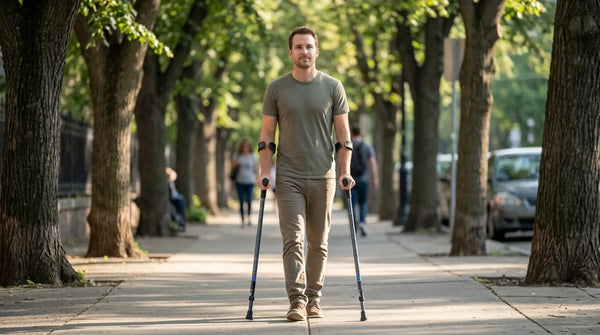
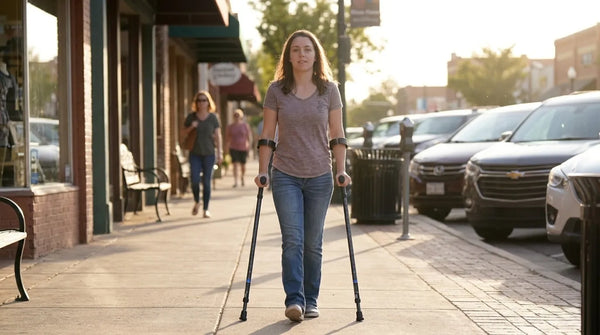
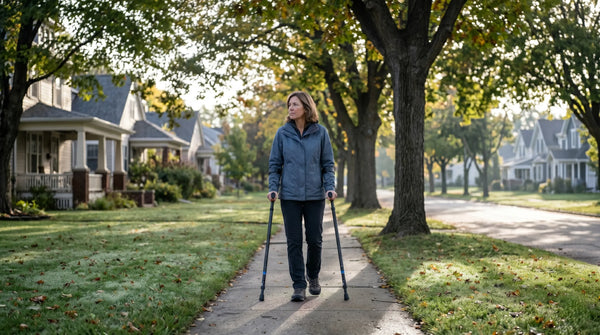
If you've only ever pictured the classic underarm crutches — the ones that tuck under your armpits — it's worth knowing those were really designed for short-term injuries, like a sprained ankle you'll be off of in six weeks. For an ongoing condition like FND, where you may be relying on support for months or longer and where balance is part of the problem, forearm crutches are usually the better fit. Here's why.
They're built for the long haul. Long-term crutch users consistently find forearm crutches more comfortable over time, while underarm crutches tend to be the short-term choice. When you might be using support every day, that difference compounds fast.
They protect your body. Underarm crutches put pressure right into your armpit, and over extended use that can cause soreness, abrasion, and even nerve damage — a real condition sometimes called "crutch palsy." Forearm crutches move the load off that sensitive area and spread it across your forearm and hand instead.
They keep you upright and aware. Underarm crutches encourage you to slouch and stare at the ground to keep your balance. Forearm crutches naturally promote a more upright posture, which lifts your line of sight and helps you see where you're going — genuinely useful when your balance is unreliable and you're scanning for hazards.
They give you a more stable base. Forearm crutches offer a wider, more controlled base of support, which matters a lot if balance and coordination are part of your FND picture. They also free up your hands more easily, so you can open a door or grab a railing without setting everything down.
The one honest tradeoff: forearm crutches ask a bit more of your upper body and balance to master at first. But for most people managing an ongoing condition, that learning curve pays off in comfort, posture, and control that underarm crutches simply can't match.
Why the In-Motion Forearm Crutch Stands Out
Not all forearm crutches are created equal, and for FND specifically there are a few features that make a real difference. The In-Motion forearm crutches from Millennial Medical were designed with exactly this kind of long-term, every-day use in mind.
The standout feature is the patented spring-assisted, shock-absorbing tip. Instead of every step sending a jarring impact up through your wrist, elbow, and shoulder, the spring absorbs that shock and returns a bit of positive energy back into your stride. For someone dealing with FND fatigue and joint strain, less impact and a little energy return on each step adds up over a day.
The ergonomic handle is angled at roughly 24 degrees so that the bones of your hand and forearm line up naturally, taking stress off your wrists and joints rather than forcing them into an awkward position. The fully molded cuff uses a "V-design" with no irritating rivet heads or external hinges, which makes getting in and out easy and lets you go hands-free when you need to.
Put together, these features support a more natural gait while minimizing strain on your wrists, elbows, and shoulders — which is precisely what you want when you might be on your crutches for the long term. They're lightweight, durable, and adjustable to fit users from 4'2" to 6'8", so they grow with your needs rather than fighting them.
None of this replaces your physiotherapy or your care team. Think of it as the supportive partner to that work — something that keeps you safely mobile and confident on the unpredictable days, so you can keep showing up for the rehab that helps you improve.
Frequently Asked Questions About FND
Is FND a mental illness?
Not exactly. FND sits at the intersection of neurology and psychology. It's a genuine neurological condition — a problem with how the brain functions — and while stress or trauma can be a trigger for some people, plenty of others have no psychological trigger at all. It's not "all in your head" in the dismissive sense, and the symptoms are very real.
Can FND go away?
It can. Because FND involves a reversible problem with how the nervous system is working rather than permanent structural damage, symptoms can improve and sometimes resolve completely. Early diagnosis and the right multidisciplinary treatment improve the odds.
Why are my scans normal if something is clearly wrong?
Because FND is a problem with brain function, not structure. Standard imaging looks at the hardware, and in FND the hardware is intact — it's the signaling that's off. Normal scans don't mean nothing is wrong; they're actually part of the FND picture.
Are forearm crutches better than underarm crutches for FND?
For ongoing, long-term use and for people managing balance problems, forearm crutches are generally the better choice. They're more comfortable over time, protect against underarm nerve damage, encourage upright posture, and offer a more stable base. Always coordinate any mobility aid with your physiotherapist so it fits your overall rehab plan.
Will using crutches make my FND worse or hold back my recovery?
Used thoughtfully and in partnership with your care team, a good mobility aid keeps you safe and active — and staying active is part of getting better. The key is using it as a tool within your treatment plan, not as a substitute for the physiotherapy that helps retrain your movement. Talk to your physio about the right role for it.
Moving Forward
FND can feel isolating, especially in those early days when you're still collecting normal test results and trying to explain to people why your body won't cooperate. But understanding the condition is the first real step toward managing it. It's common, it's legitimate, it's treatable, and — crucially — it can get better.
While you do the work of recovery, you deserve mobility support that keeps you upright, comfortable, and confident. If unpredictable walking days are part of your FND, it's worth looking into forearm crutches built for the long haul. The In-Motion forearm crutches from Millennial Medical were designed for exactly this — steady, comfortable, every-day support that moves with you.
This article is for educational purposes and isn't a substitute for personalized medical advice. Always work with your neurologist, physiotherapist, and care team to decide what mobility support is right for your situation.