Resource Center — Long-Term Conditions
Ankylosing Spondylitis and Crutches: When You Actually Need Mobility Support (and When You Don't)
If you have ankylosing spondylitis and you have started wondering whether crutches are in your future, here is the honest answer up front. Most people with AS never need them. The disease is about stiffness and inflammation in your spine, and a crutch does nothing for a stiff spine. So if someone handed you a pair at diagnosis, they got ahead of the situation.
But that is not the whole story, and you probably already sense that, or you would not be reading this. AS does not stay in one place. For some people it settles into a hip. For others it slowly fuses the spine into a rigid column that breaks more easily than it should. A smaller number end up needing a hip replacement, and that comes with its own recovery on crutches. So the real question is not “do AS patients use crutches.” It is “what would have to happen for me to need them, and what should I do about it now.”
That is what this guide covers. We will walk through where mobility support actually fits, the warning signs that matter, and why the type of crutch you choose matters more for AS than for almost any other condition.
Recovering from a different procedure or living with a different condition? Try our companion guides for hip replacement, knee replacement, and Ehlers-Danlos syndrome.
The Honest Answer to “How Long?”
People ask “how long will I be on crutches” expecting a number. With AS, the better question is whether you will need them at all, and for that there is no single timeline. AS is a lifelong condition that usually shows up between ages 17 and 45, with most people noticing it in their twenties and thirties. The average age of onset worldwide is around 26. You are looking at decades of living with this, not a recovery you count in weeks.
For most of those decades, most people walk independently. The thing that changes the picture is whether the disease moves into your hips or damages a joint badly enough to need surgery. When a hip is involved, the time on crutches is no longer open-ended. It looks like a defined recovery, and we will give you the real weeks below.
The one thing most patients do not know going in: the biggest determining factor for whether you ever need a mobility aid is not how much your back hurts. It is whether your hips get drawn in. Spinal pain is miserable, but the spine is not what carries you across a room. The hip is. Keep an eye on the hip.
The Different Ways AS Can Lead to Crutches
AS does not have one path. It has a few, and they are very different from each other. Knowing which one you might be on changes what you watch for and what you do about it.
Hip involvement
This is the big one. AS is not only a spine disease. The hips get involved in roughly 19 to 36 percent of patients, and when one hip is affected the other usually follows. Among people who do develop hip disease, somewhere between half and ninety percent have it on both sides. Hip involvement is the single most common reason an AS patient ends up using a cane or crutches, because the hip is the joint that actually does the walking. When it stiffens and the cartilage wears down, distance and stairs get hard, and support helps.
After hip or knee replacement
When hip damage gets bad enough, a total hip replacement is a well-established fix, and outcomes in AS patients are good. People get real pain relief and walk farther afterward. The catch is that any joint replacement comes with a crutch phase. This is the most predictable reason an AS patient will be on crutches, and unlike the disease itself, it has a clear end date.
Spinal fracture in a fused spine
This is the one nobody warns patients about, and it is the most serious. Over years, AS can fuse the spine into a single rigid column, sometimes called a bamboo spine. A rigid spine does not bend, so it behaves like a long bone. It snaps. People with AS break their spines four to eight times more often than the general population, and the lifetime risk of a spinal fracture runs as high as 14 percent. The frightening part is how little it takes. In most of these fractures the trauma was minor, a slip or a low fall that would not have hurt a normal spine. These breaks tend to go through all three columns of the spine at once, which makes them unstable and dangerous. Recovery from one can absolutely involve mobility aids, but the headline here is prevention, not crutches.
Advanced posture changes and balance
As AS progresses, some people develop a forward-stooped posture from spinal kyphosis. That shifts your center of gravity forward and changes how you balance. Balance is measurably worse in AS than in healthy people, and about a third of patients report a fall in the past year. Loss of neck rotation makes it worse, because you cannot turn your head to check your footing. For people in this situation, a cane or a pair of crutches is sometimes less about a damaged joint and more about staying upright and confident on your feet.
A Realistic Timeline (If You Have a Hip Replacement)
Your surgeon’s specific instructions take priority over any general timeline. AS hips can be more involved than a standard arthritic hip, so your team may move faster or slower than what follows. With that said, here is what recovery on crutches after a hip replacement usually looks like for AS patients.
- Day 1: You are up and walking with crutches or a walker, often within 12 to 24 hours of surgery. Most modern protocols allow weight on the new hip right away.
- Weeks 1 to 4: Two crutches. You are working with a physical therapist on safe walking, getting in and out of bed, and the movement limits your surgeon sets. Your home setup matters most during this stretch.
- Weeks 4 to 8: Most patients step down to a single crutch or cane as strength returns, putting partial weight on the operated side.
- Walking crutch-free: Many people are off crutches entirely somewhere in the five to eight week range. The average time to walk crutch-free lands between roughly 4.6 and 7.3 weeks, with more eroded, more damaged hips taking longer.
- Beyond: Outpatient PT two to three times a week for about a month after you are home, then continued strengthening. Walking distance keeps improving for months.
The Rules That Matter Most
If you take nothing else from this guide, take these.
Protect your spine like it is fragile, because eventually it might be. If your AS has been fusing your spine for years, treat falls as a serious risk, not an annoyance. The fractures that put AS patients in the hospital usually come from small accidents. Clear your floors and light your stairs. Hold the rail every single time. This habit prevents more harm than any crutch ever will.
Keep moving, even when moving is the last thing you want to do. Exercise and physical therapy are the backbone of AS care, not an optional add-on. Motion keeps your spine and hips as mobile as the disease will allow. It also protects your balance and slows the stiffening. A body that keeps moving needs mobility aids later, if at all.
Watch the hip, not just the back. Pain deep in the groin, a limp that creeps in, trouble putting on socks or getting out of a low chair. These are hip signals, and the hip is what determines whether you stay independent on your feet. Tell your rheumatologist early, because the sooner hip involvement is managed, the better the long game goes.
Get on top of the inflammation. NSAIDs and biologic medications like TNF inhibitors and IL-17 inhibitors do the real work of controlling AS. Calmer disease means less joint damage over time, which means less chance of ending up needing support to walk.
Setting Up Your Home Before Surgery
If you have a hip replacement on the calendar, the work you do beforehand pays off in the first hard weeks. You will be moving carefully and you will tire quickly, so the goal is to remove every reason to bend, reach, or rush.
Clear a wide, clutter-free path through the rooms you use most. Crutches need room, and a fused or stiff spine cannot twist out of the way of a coffee table you forgot about. Roll up loose rugs and tape down cords. Put the things you use daily between hip and shoulder height so you are not reaching to the floor or up to a top shelf.
Set up a recovery station near where you will sit, with water, medications, phone, charger, and a grabber tool within arm’s reach. A firm chair with armrests is easier to rise from than a soft couch. In the bathroom, a raised toilet seat and a shower chair take pressure off the new hip and off your spine. If you have stairs, plan to take them slowly with the rail, and set up a living space on one floor for the first week or two if you can.
AS adds one more consideration most surgery prep guides miss. Because your spine may not bend much, the usual advice to “reach down carefully” does not apply to you. A long-handled reacher, a sock aid, and a long shoehorn are not luxuries. They are how you get dressed without putting your spine or your new hip in a bad position.
Why Crutch Choice Matters More for AS Than for Almost Anyone
Here is where AS is genuinely different. The standard underarm crutch was designed around an assumption that does not hold for you, that the person using it has a flexible spine and full, painless shoulder movement. AS works against both.
Underarm crutches pivot from a point high up under the arm, on average about 62 percent higher than a forearm crutch. That high pivot demands more shoulder motion and more upper-body effort with every step. For someone whose shoulders or upper spine are stiff from AS, that is a real problem. The same crutches load the soft tissue under the arm, and pressure there can compress the nerves that run through the armpit. The result, sometimes called crutch palsy, is weakness and numbness in the arm. It is preventable, and the way you prevent it is by not loading the armpit in the first place.
The forces involved are not small. Peak hand-grip force during crutch use can reach 70 to 115 percent of body weight, and the load driven back up through the arms can hit more than 40 percent of body weight on each step. Those numbers exceed the loads occupational ergonomics standards consider safe for repetitive use. Put that strain on a body already managing inflammatory joint disease and you are asking for trouble in the wrists and hands.
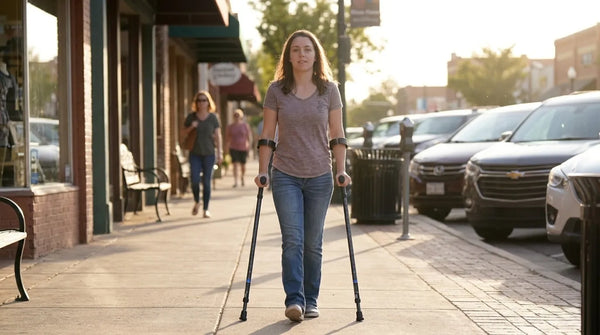
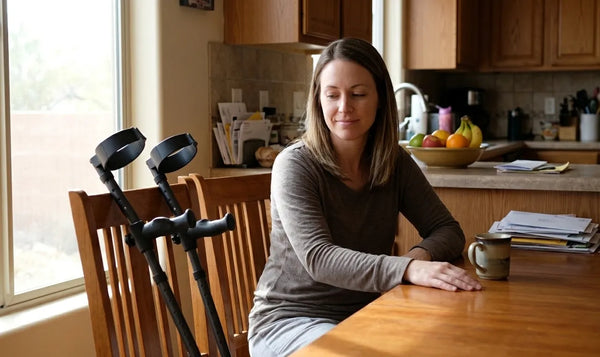
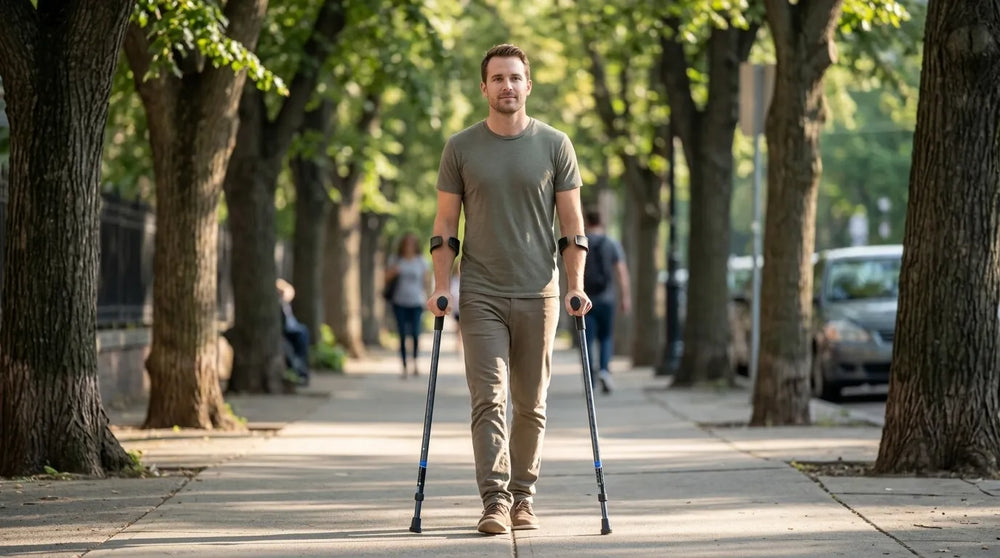
This is the reasoning behind the In-Motion crutch. It is a forearm-style design built around a contoured arm platform, so the load travels down through the forearm and a neutral wrist instead of pressing into the armpit or hanging off the hand. That keeps the high shoulder motion of an underarm crutch out of the equation, which matters when AS has limited how far your shoulders and upper spine can move. The design came out of three years of development and 34 medical studies on how crutches load the body. For someone with AS, the point is simple. If you are going to spend time on crutches, whether for a hip recovery or for daily balance, you want the one that asks the least of the joints your disease is already affecting. See the In-Motion forearm crutch here.
When to Call Your Surgeon or Doctor
Some symptoms can wait for your next appointment. These cannot.
Call right away, or go to the emergency room, if you have any new back or neck pain after a fall or even a minor bump, especially if your spine has been fusing over the years. A new, changing, or severe spinal pain in an AS patient is treated as a fracture until proven otherwise, because that is so often exactly what it is. New weakness, numbness, tingling in the arms or legs, or any loss of bladder or bowel control is an emergency. It can mean the spinal cord is involved.
After a hip replacement, certain signs mean call now. Calf pain, swelling, warmth, or redness in one leg can signal a blood clot, a deep vein thrombosis. Sudden shortness of breath, chest pain, or coughing up blood can mean that clot has traveled to the lungs, a pulmonary embolism, and that is a call-911 situation. Do not wait it out. Also call for fever over 101 degrees, drainage or spreading redness at the incision, a sudden increase in hip pain, or your leg suddenly looking shorter or turned out, which can mean the new hip has dislocated.
The Bottom Line
Ankylosing spondylitis is a long road, and crutches are not a fixed stop on it. Plenty of people travel the whole way without them. The ones who do need support usually need it for a specific reason, most often a hip that wore out or a joint that was replaced, and those are situations you can see coming and prepare for.
What determines how this goes is not luck. It is staying in motion, controlling the inflammation early, guarding your spine against falls, and paying attention to your hips before they force the issue. Do those things and you tilt the odds hard in your favor.
And if you do find yourself reaching for a crutch, for a recovery or for steadier footing, remember that the right one is a tool that works with your body instead of against it. With AS, that is not a small detail. It is the difference between support that helps and support that adds one more sore joint to manage.
Frequently Asked Questions
Do most people with ankylosing spondylitis end up needing crutches?
No. Most people with AS walk independently throughout their lives. Crutches come into the picture mainly when the disease affects a hip, when a joint is replaced, or when a fused spine and changing posture make balance a concern. For the average person with AS, the focus is on exercise and medication, not mobility aids.
Why does AS affect the hips if it is a spine disease?
AS is an inflammatory arthritis, and while it favors the spine and the sacroiliac joints, it can inflame other large joints too. The hips are the most common of these, affected in roughly 19 to 36 percent of patients. When a hip is involved it tends to involve both sides, and because the hip carries your body through every step, hip disease is the most likely reason an AS patient loses walking independence.
If I need a hip replacement, how long will I be on crutches?
Most people start walking with crutches within a day of surgery, move to a single crutch or cane around the second month, and walk without support somewhere between five and eight weeks after surgery. The average time to walk crutch-free falls in roughly the 4.6 to 7.3 week range, with more damaged hips taking a bit longer. Your surgeon’s instructions come first.
Are underarm crutches a bad idea for someone with AS?
They are often a poor fit. Underarm crutches need more shoulder movement and more upper-body effort, and AS frequently limits shoulder and upper-spine motion. They also press on the nerves under the arm, which can cause weakness and numbness. A forearm crutch with a supportive arm platform keeps the load off the armpit and off a fully extended reach, which suits an AS body better.
I have a fused spine. Should I be worried about falls?
Yes, and this is the most important thing in this article. A fused, rigid spine fractures far more easily than a normal one, often from minor falls. AS patients break their spines four to eight times more often than the general population. Fall-proof your home, use a rail on stairs, and treat any new spinal pain after even a small bump as something to get checked promptly.
Will using a crutch make me weaker or more dependent?
Used for the right reason, a crutch does the opposite. It keeps you moving and active, walking farther than you could without it, which protects strength and balance. The goal is not to avoid support out of pride. It is to keep living fully, and sometimes the right tool is what makes that possible. Where it helps, use it, and keep up the exercise your rheumatologist or PT recommends alongside it.
Related Recovery Guides
- How to Use Crutches After Hip Replacement Surgery: A Complete Recovery Guide
- Knee Replacement Recovery: A Patient’s Guide to the Crutch Phase
- Crutches for Ehlers-Danlos Syndrome
- Crutches for Multiple Sclerosis
- Crutch Palsy: A Warning About Underarm Crutches
- Should I Use Underarm or Forearm Crutches?