Resource Center — Long-Term Conditions
Crutches and Ehlers-Danlos Syndrome: A Real-World Guide for the EDS Community
If you have EDS, you already know that standard medical advice doesn't quite apply to you. Your joints work differently. Your connective tissue behaves differently. And when it comes to mobility aids, the equipment most people get handed at a hospital or pharmacy can cause more damage than the problem you're trying to manage.
This is especially true for crutches. Most people encounter crutch use after a broken leg or a post-surgical recovery. They get a pair of axillary underarm crutches, learn a three-point gait, and go home. For someone with healthy connective tissue, that works fine. For someone with hypermobile Ehlers-Danlos syndrome or another EDS subtype, those same crutches can sublux a shoulder, overload an already-compromised wrist, or compress the brachial plexus. Sometimes on the first day.
That's not a worst-case scenario. It's anatomy. What follows is a realistic guide to crutch use with EDS: which types of crutches create problems, which designs actually help, when crutches are the right tool at all, and how to protect the joints you're loading while you protect the ones you're resting.
Managing a different long-term condition? See our companion guides for Transverse Myelitis and Mobility Aids, Functional Neurological Disorder: A Patient's Guide to Crutches, and our Crutch Fitting Guide for Physical Therapists.
The Honest Answer to "Do I Even Need Crutches?"
With post-surgical recovery, the question is how long until you're off crutches. With EDS, the question is whether crutches help or harm. And the answer depends entirely on which joints are your most affected.
If your lower body is less stable than your upper body, forearm crutches can help you stay ambulatory and reduce load on unstable knees, ankles, and hips. If your wrists, elbows, and shoulders are also hypermobile, the same crutches can create new problems. The goal is to offload the unstable joints below without overloading the ones above.
Most EDS patients who use crutches don't use them the way a post-surgery patient does. They use them situationally: on bad flare days, in high-demand environments like airports or amusement parks, after a subluxation or dislocation, or during POTS flare-ups when staying upright costs disproportionate energy. That's a different use pattern than full-weight-bearing every day, and it changes how you choose and fit your equipment.
The biggest determining factor for whether crutches work for you is upper limb stability. If your wrists and shoulders are significantly affected, you may do better with a rollator walker, which transfers load to the palms and forearms without requiring grip strength. A physical therapist who specializes in hypermobility conditions can help you assess this before committing to a crutch design.
Understanding EDS: The 13 Subtypes and Why They Matter for Mobility
Ehlers-Danlos syndrome is a group of heritable connective tissue disorders. There are 13 recognized subtypes, all involving defects in collagen production or processing, but they present very differently from person to person and even between subtypes.
Hypermobile EDS (hEDS) is the most common subtype. It does not yet have an identified genetic marker, which makes diagnosis clinical. Its defining features are joint hypermobility, joint instability, and chronic musculoskeletal pain. Classical EDS, vascular EDS, kyphoscoliotic EDS, and others each have distinct genetic causes and different tissue fragility profiles.
For crutch use, the most relevant subtypes are hEDS and classical EDS, where joint instability and pain are the primary mobility challenges. Vascular EDS, with its risk of arterial rupture, makes axillary crutches particularly dangerous because of the compression they place on axillary vessels. If you have vascular EDS and need a mobility aid, this is a conversation for your vascular specialist, not just a general practitioner.
POTS (postural orthostatic tachycardia syndrome) is a common comorbidity in hEDS. It affects how you tolerate being upright. For POTS patients, the energy cost of walking matters a great deal. Any crutch design that increases energy expenditure makes POTS symptoms worse.
Why Standard Axillary Crutches Are the Wrong Tool for EDS
Standard underarm crutches were designed for short-term post-fracture use in people with stable connective tissue. For EDS patients, they create several specific problems.
Axillary nerve compression. The padded top of a standard crutch rests in the axilla (armpit). Prolonged or repeated pressure there compresses the brachial plexus, which can cause numbness, tingling, and weakness in the arm and hand. This is called crutch palsy, and it is not rare.
Shoulder subluxations. For hEDS patients with shoulder hypermobility, the overhead reach and weight-bearing pattern of axillary crutches puts the glenohumeral joint in a position where it is prone to subluxation. Studies measuring peak hand-grip force during axillary crutch use report values that can reach 70 to 115 percent of body weight on stairs.
Wrist and hand overload. Every step on a standard crutch loads the hand, wrist, and carpal joints. For someone with hypermobile wrists, that load compounds over a day. Carpal tunnel irritation and wrist subluxations are both reported in the EDS community from standard crutch use.
Forearm Crutches: A Better Option, Used Carefully
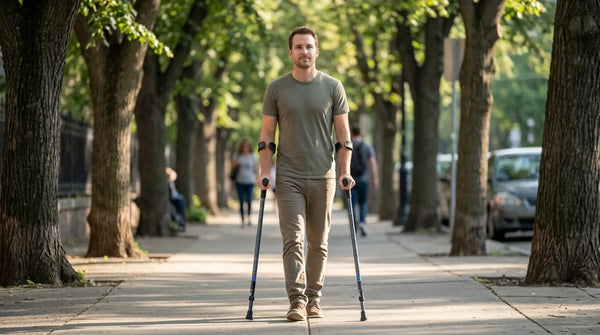
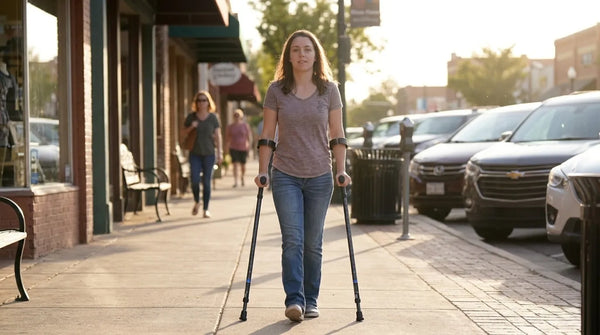
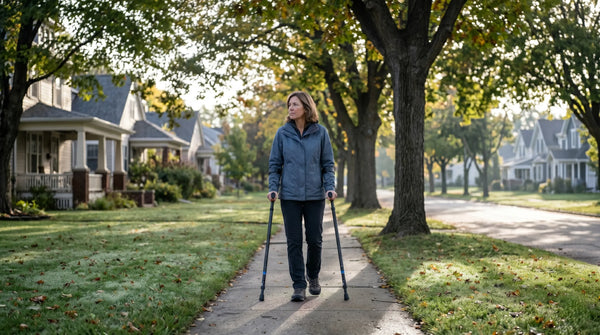
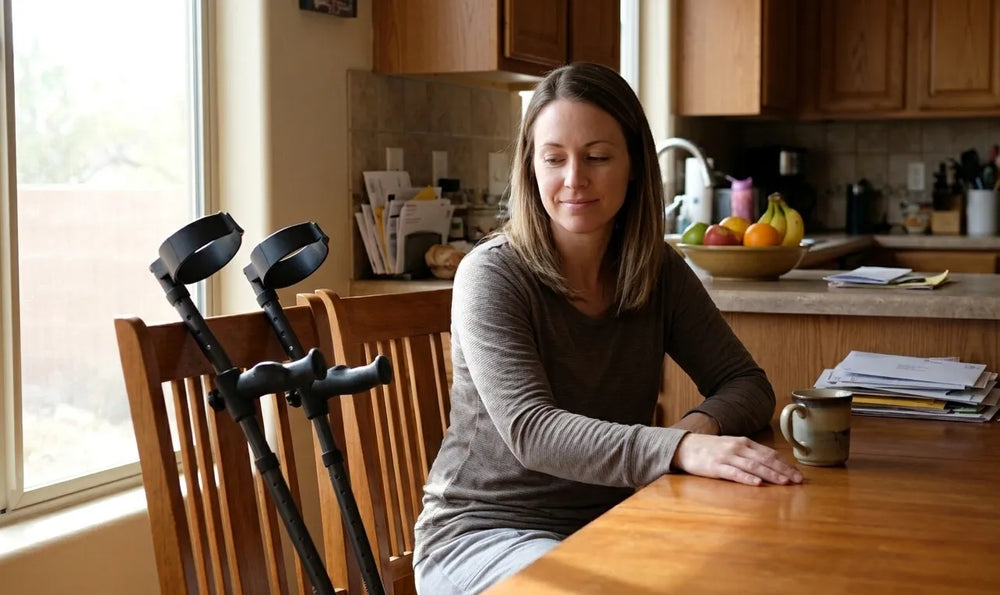
Forearm (elbow or Lofstrand) crutches are the right starting point for most EDS patients who need a crutch. They eliminate axillary compression entirely. They allow you to release the grip without dropping the crutch. And when properly designed, they distribute load along the forearm rather than concentrating it at the wrist.
The critical variable is the cuff and arm platform. A standard forearm crutch still uses a pistol-grip handle, which loads the same wrist and hand structures that cause problems. What matters for EDS patients is a design that shifts the load-bearing point up toward the forearm, away from the hand and wrist.
This is where ergonomic forearm crutch designs make a practical difference. A contoured forearm platform distributes the contact surface over a larger area of the forearm. That spreads the load and reduces peak pressure at any one joint. It also reduces the wrist deviation that occurs when you grip a standard handle.
Even with the best crutch design, wrist instability in EDS may require additional support. Many EDS patients use wrist splints in combination with forearm crutches, particularly on high-use days. Your PT can help you determine the right combination.
The Rules That Matter Most for EDS Crutch Use
Fit the crutch to your hypermobile body, not to the standard fitting guide. Standard fitting guides position the handle so your elbow is bent 15 to 30 degrees. For hEDS patients, this can put the wrist in a position of ulnar deviation under load. Have a PT who understands hypermobility check your alignment.
Protect your upper limbs as much as you protect your lower ones. If you're creating new instability in your wrists, elbows, or shoulders while trying to offload a lower limb joint, you haven't solved the problem. If upper limb symptoms worsen after starting crutch use, stop and reassess.
Use situationally, not habitually, if that fits your condition. For many hEDS patients, crutches as a situational tool preserve more function than using them all day every day. This is not universal. Progressive joint deterioration may require more consistent use. It's worth discussing with your care team.
Expect an adjustment period and listen to your body. New crutch users often develop muscle soreness in the upper arms and shoulders in the first week. For EDS patients, that adaptation period can reveal which joints are being overloaded before cumulative damage occurs.
Setting Up Your Home for Long-Term Crutch Use
EDS crutch use is often indefinite rather than time-limited. That means home setup matters more than it does for post-surgical patients who'll be off crutches in six weeks.
Clear pathways throughout your home remove rug, threshold, and furniture hazards that become risky when your joints are unstable and you're weight-bearing differently. Grab bars in bathrooms allow you to put the crutch down and use a fixed support when needed. Seats at the right height reduce joint stress by letting you stand without a full squat. And keeping a spare set of crutches at work or in the car means you're not caught without them when a flare arrives unexpectedly.
Why Crutch Design Matters More for EDS Than for Most Conditions
For post-surgical patients, almost any forearm crutch will work for a six-week recovery. EDS patients who use crutches long-term are in a completely different situation. The cumulative effect of a suboptimal crutch design on hypermobile joints, over months or years, is not the same as six weeks of mild discomfort.
Standard forearm crutches concentrate force at the hand and wrist through a pistol-grip handle. That force, applied thousands of times a day over months, creates overuse patterns in hypermobile wrist structures that are already predisposed to injury. Ergonomic forearm crutch designs address this directly.
The In-Motion crutch was developed over three years with input from 34 medical studies specifically examining crutch-related biomechanical problems. Its contoured arm platform shifts the primary load point from the hand to the forearm, reducing wrist loading in a way that matters for EDS users who need a crutch long-term rather than just through a recovery window.
When to Call Your Doctor or PT
New or worsening numbness or tingling in the arm or hand after starting crutch use can indicate nerve compression and should be assessed promptly. A shoulder, elbow, or wrist subluxation that occurred during crutch use warrants a reassessment of fit and technique before continuing. Increasing wrist, elbow, or shoulder pain after the first few weeks of crutch use that is getting worse week over week is not a normal adaptation.
If you have vascular EDS and are considering a crutch, speak with your vascular specialist before starting. Axillary compression in vascular EDS carries specific risks related to arterial fragility. Any significant worsening of POTS symptoms after beginning crutch use may indicate that the energy cost is too high, and a different design or aid may be needed.
The Bottom Line
Crutches can be genuinely helpful for EDS patients who need to stay mobile while managing joint instability. They are not without risk in a hypermobile body. The risks are manageable when you choose the right type of crutch, fit it correctly for your specific joints, and use it in a way that protects your upper limbs as much as your lower ones.
The EDS community has been figuring this out largely on its own for years, sharing information through patient forums and advocacy organizations because the medical system rarely has ready answers. Standard crutches were not designed for your body. Better options exist, and getting to the right one is a matter of honest assessment and good PT guidance.
Frequently Asked Questions
Can I use crutches if I have wrist instability from EDS?
Possibly, with the right design. Standard pistol-grip forearm crutches load your wrists through the handle. Ergonomic forearm crutches with a platform design distribute force along the forearm instead, which significantly reduces wrist loading. Wrist splints worn during crutch use can add external stability. If your wrist instability is severe, a rollator walker may be a better primary mobility aid.
Are forearm crutches better than underarm crutches for EDS?
Yes, for nearly all EDS patients. Axillary crutches compress the brachial plexus and create shoulder subluxation risk. Forearm crutches eliminate axillary compression entirely. Ergonomic platform designs are better still because they reduce wrist loading.
How do I know when I need crutches versus just a cane?
A cane offloads roughly 15 to 20 percent of your body weight from the affected side. A forearm crutch offloads considerably more, up to 40 to 50 percent depending on your gait pattern. If a cane provides enough support for your level of instability and pain, start there. Crutches are appropriate when instability is more significant or when you need to completely rest a lower limb joint.
Will crutches make my shoulder subluxations worse?
Axillary crutches carry a real risk of worsening shoulder instability in hEDS. Forearm crutches carry less risk, but shoulder hypermobility still means careful attention to technique. If you're already experiencing frequent shoulder subluxations, address shoulder stability with a PT before starting forearm crutch use.
Can I use crutches if I also have POTS?
Many EDS patients with POTS use crutches successfully. The key consideration is energy expenditure. Standard crutches require significantly more energy than walking, which can trigger POTS symptoms. Lightweight ergonomic forearm crutches reduce the energy cost of crutch use. Some POTS patients also find that using crutches intermittently rather than all-day helps manage energy while still having support when needed.
What is the difference between forearm crutches and a rollator for EDS?
Forearm crutches require you to pick them up and swing them with each step, providing precise control of weight bearing but demanding more from the upper limbs. A rollator rolls continuously and transfers weight through the forearms to a frame rather than to your hands. Rollators are generally better for EDS patients with significant upper limb involvement, because they reduce grip demand and allow forward lean. The trade-off is that rollators are less maneuverable in tight spaces.
Is there an EDS-specific crutch fitting protocol?
There is no published EDS-specific fitting protocol, but several principles apply. Standard fitting guidelines are a starting point, not an endpoint. You want to verify that your wrist is in a neutral position under load, not deviated. You want to confirm the cuff position does not compress any joint. An OT or PT with hypermobility experience is worth seeking out for a fitting.
Related Guides
- Functional Neurological Disorder: A Patient's Guide to Mobility Aids
- Transverse Myelitis and Long-Term Crutch Use
- Crutch Fitting for Physical Therapists
- The Clinical Case for Ergonomic Crutches
- Returning to Work on Crutches
- Ankylosing Spondylitis and Crutches: When You Actually Need Mobility Support