Resource Center — Mobility Products
The Best Crutches for Veterans and Why Standard-Issue Falls Short
If you've been handed a pair of aluminum crutches at a hospital or VA facility, you probably didn't think much about it. You needed something to walk on, they gave you crutches, you left. That's how most people experience it.
But if you're a veteran who needs crutches for more than a few weeks, and a lot of veterans do, what you're given matters a lot more than most people realize. The wrong crutch, used long enough, doesn't just fail to help. It actively causes new problems.
This post is about why the standard issue falls short, what actually makes a crutch better for long-term use, and what your VA benefits can do to get you something worth using.
Veterans use crutches longer than most people
This isn't an assumption. It's in the data. Veterans have musculoskeletal injuries at rates significantly higher than civilians: back problems, knee issues, hip conditions from years of carrying load in tough terrain, lower leg injuries from training. These are incredibly common in the veteran population.
Research shows veterans are almost three times more likely to report back and neck problems compared to civilians their age. Hip and knee injuries are among the most common service-connected disabilities. A lot of these conditions either require surgery and the recovery that follows, or they're long-term chronic situations that mean crutches for months or years.
Standard aluminum crutches were designed for short-term use: a few weeks, maybe a month. They weren't built for a veteran managing a post-surgery recovery for six months, or someone with a permanent mobility limitation.
What actually goes wrong with standard crutches
It's not that they don't work. They do work in the most basic sense. The problem is what they do to your body over time.
Your wrists take a beating
Standard crutch handgrips are designed to be cheap and universal, not ergonomic. They force your wrist into an unnatural flat angle with every single step. Over thousands of steps a day, week after week, that leads to repetitive stress injuries: carpal tunnel, tendinitis, nerve pain in the hand. A lot of long-term crutch users end up with wrist problems just as serious as whatever put them on crutches in the first place.
Every step hits hard
There's no shock absorption in a standard aluminum crutch. When the tip hits pavement, that impact goes straight up the crutch into your hands, wrists, elbows, and shoulders. Do that ten thousand times a day and the cumulative effect on your upper body is significant.
They're built for hospital floors, not real life
Standard rubber tips are designed for flat, smooth surfaces. Put them on grass, gravel, a sloped driveway, or a wet sidewalk and they lose traction fast. For veterans who want to actually get around in the real world, and not just navigate a clinic hallway, that's a real safety problem.
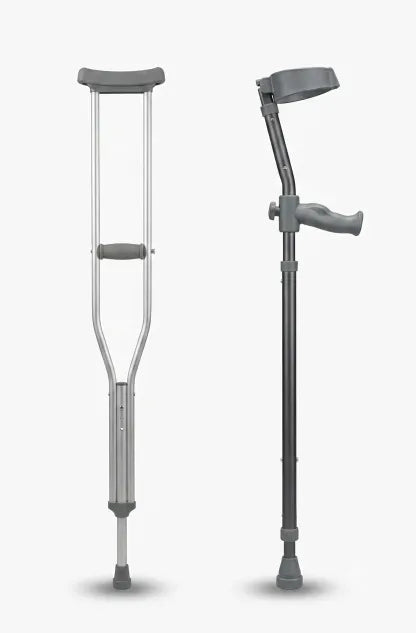
Underarm crutches can damage nerves
Long-term use of axillary (underarm) crutches can compress the radial nerve in your armpit, causing numbness, weakness, and tingling in the hand. It even has a name: crutch palsy. It doesn't happen overnight, but it happens, and it's more likely with poorly designed underarm pads and improper fit.
They just wear you out
Standard crutches give nothing back. Every step is pure upper body effort with no assist from the equipment. If you're already managing pain, fatigue, or other physical challenges on top of mobility limitations, that constant drain compounds quickly.
What in-Motion crutches do differently
in-Motion crutches were built specifically to solve these problems. Not as a marketing angle, as an engineering goal. The design was developed and refined through 34 clinical studies, which is more research than any comparable crutch product has behind it.
The spring changes everything
The most distinctive feature of in-Motion crutches is the spring mechanism built into the lower post. It does two things: it absorbs the impact of each step so your wrists and shoulders don't have to, and it returns that energy back to you on the upswing so each step takes less effort.
One customer who has been using in-Motion crutches for over 20 years described it this way: the spring pushes back up, removing some of the fatigue that occurs when walking. That's not an ad, that's what the design actually does.
The grip is actually ergonomic
in-Motion handgrips are shaped and angled to keep your wrist in its natural position. Not flat. Not forced. Just how your wrist would sit if you weren't gripping anything. That small change, multiplied over every step you take, makes a significant difference in preventing the long-term wrist problems that standard crutches cause.
The tip adjusts to the terrain
in-Motion uses an articulating tip that maintains full ground contact at any angle, not just straight up and down. On a slope, on grass, on gravel, on an uneven sidewalk, the tip stays planted. That's the difference between feeling confident on crutches and feeling like you're one bad step from falling.
Built for actual adults
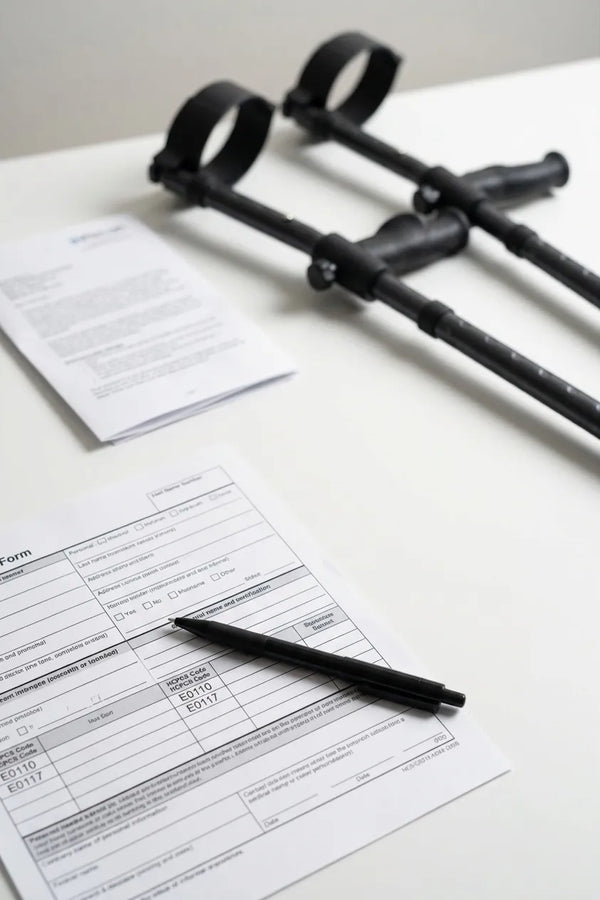
350 lb. weight capacity. Available in sizes covering most adults. Both forearm (E0110) and underarm (E0117) configurations available. FDA Registered and Listed. These are specs built for real-world, long-term use by people who actually need them.
Your VA benefits can cover this
in-Motion crutches are coded under E0110 for the forearm model and E0117 for the underarm model, the same codes the VA uses to process DME orders. For most veterans with service-connected conditions, getting in-Motion crutches through the VA costs nothing.
The process:
- Enroll in VA health care if you haven't: va.gov or 1-877-222-8387
- See your VA provider or a VA Community Care Network provider near you
- Ask for in-Motion crutches by Millennial Medical (E0110 forearm or E0117 underarm)
- Your provider includes the brand and code on VA Form 10-10172 when they submit it
- VA's Prosthetics department fulfills the order
If you're being discharged after surgery, ask for in-Motion on the spot. Community care providers can hand them to you before you leave with no pre-authorization required.
Not sure where to start? Our full guide to VA crutch coverage walks you through the whole process, including the HCPCS billing codes to give your provider.
Free download: What to bring to your appointment
We put together a one-page reference sheet with the product names, billing codes, and a provider script. Print it and bring it with you.
Download the VA Appointment Reference Sheet (PDF)
You've earned better equipment
We started Millennial Medical because we believed veterans and active people deserve crutches built for real use, not just temporary fixes. Thirty-four clinical studies. FDA clearance. Real engineering. That's what went into in-Motion crutches.
Your VA benefits exist to take care of you. Use them.
Shop in-Motion or reach out if you need help navigating VA benefits: millennialmedical.com
Be kind. Be generous. Always pay it forward.
More in the Veterans Series
All six posts in this series are linked below. They're written to stand alone, but they work best together.
- Post 1 of 6: Does the VA Cover Crutches? Yes, Here's Exactly How It Works
- Post 2 of 6: How to Get the Crutches You Actually Want Through the VA
- Post 3 of 6: TRICARE vs. VA Benefits for Crutches: A Straight Comparison
- Post 4 of 6: HCPCS Codes E0117 and E0110: What Veterans Need to Know
- Post 5 of 6: Getting Crutches Through the VA Community Care Network
- Post 6 of 6: The Best Crutches for Veterans and Why Standard-Issue Falls Short (this post)
All posts are also available on our Veterans hub page.
This guide is part of our VA Benefits Crutches Resource Hub, where you'll find every option for getting crutches covered.