Resource Center — Veteran Info
Does the VA Cover Crutches? Yes, Here's Exactly How It Works
Short answer: yes, the VA covers crutches. But that one-line answer doesn't do you much good when you're sitting in a waiting room trying to figure out what to actually say to get the equipment you need.
So let's walk through how the benefit works, who qualifies, what it actually costs out of your pocket, and how to make sure you walk away with a pair of crutches worth using and not just whatever's cheapest in the storage room.
What counts as a crutch under VA benefits?
Crutches fall under a category the VA calls Durable Medical Equipment, or DME. The basic idea is this: if a piece of equipment is medically necessary for you to function and you use it outside of a hospital setting, it qualifies as DME.
The department that handles this is called the Prosthetic and Sensory Aids Service, or PSAS. Don't let the name throw you off. Even though they say prosthetic, PSAS handles all kinds of mobility equipment: crutches, walkers, canes, wheelchairs, and braces. If it helps you move around, PSAS is involved.
And here's something most veterans don't realize: the VA doesn't just cover the initial pair. They also cover repairs and replacements. If your crutches wear out or break, that's covered too.
Who qualifies?
If you're enrolled in VA health care and a VA provider writes you a prescription saying you need crutches, you're covered. That's really it.
You don't need a service-connected disability to get crutches. You don't need a specific disability rating. You just need to be enrolled in VA health care and have a legitimate medical need.
Your disability rating does affect how much you pay, if anything. We'll get to that below. But the basic eligibility question is simple: Are you enrolled? Does a provider say you need them? Then you qualify.
About half of veterans who are eligible for VA health care have never enrolled. If that's you, there's no penalty for signing up late. You can do it at va.gov, by calling 1-877-222-8387, or by walking into any VA Medical Center.
What does it actually cost you?
The VA uses a priority group system with eight groups total to determine what veterans pay for care and equipment. Here's the practical breakdown for crutches:
Groups 1 through 4: Veterans with service-connected disability ratings of 10% or higher, Purple Heart recipients, and former POWs. For most DME related to your service-connected condition, you pay nothing.
Groups 5 and 6: Veterans receiving VA pension, Vietnam and Gulf War veterans, Camp Lejeune vets, and others in this range. They typically pay little to nothing for equipment.
Groups 7 and 8: Veterans without service-connected conditions at higher income levels may have a small copay. Still usually far less than buying crutches out of pocket.
50% rating or higher: Everything is free. Not just care related to your rated condition, but all VA medical care.
Can you ask for a specific brand?
Yes, and this is where most veterans leave value on the table.
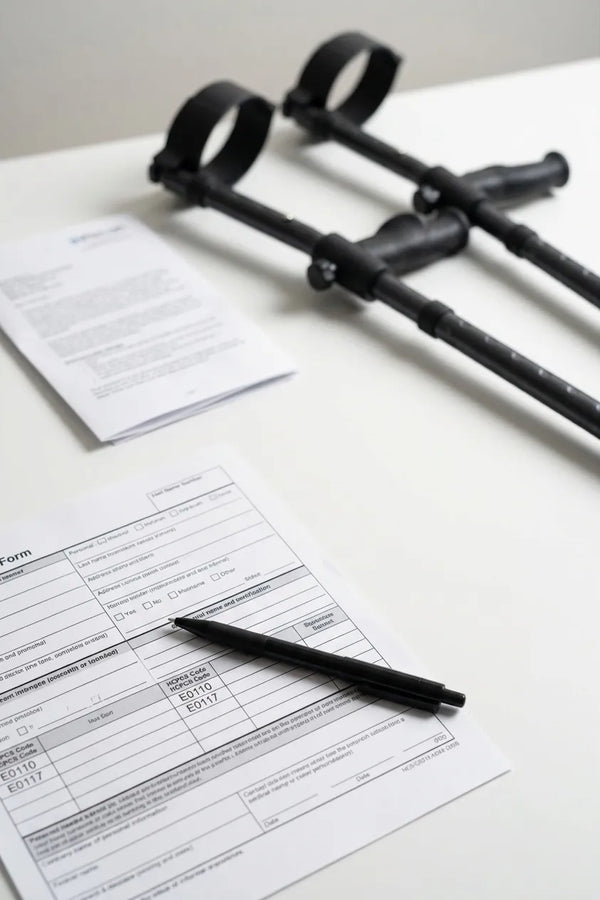
When your provider submits the paperwork to get you crutches, they fill out a form called VA Form 10-10172, the Request for Service form. There's a field on that form for brand and model. If your provider leaves it blank, the VA defaults to whatever generic aluminum crutch they have in stock.
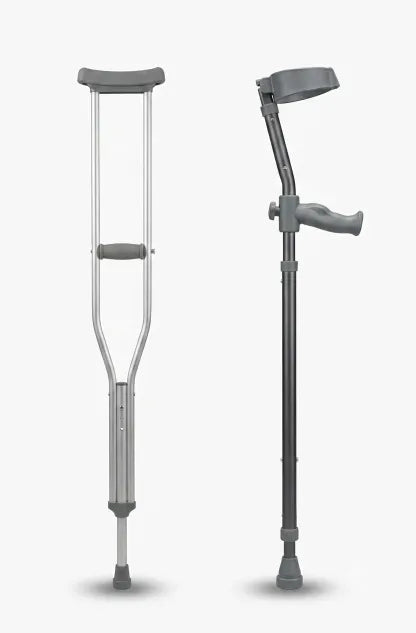
But if your provider specifically writes in "in-Motion crutches by Millennial Medical" along with the billing code E0110 for forearm models or E0117 for underarm models, that's what gets ordered. The system works when you use it.
Write down the product name and the HCPCS codes before your appointment and hand them to your provider when you ask. It takes 30 seconds and makes their job easier.
The two ways this works
There's the standard path and the urgent path, and they're pretty different.
The standard path: You see a VA provider, they prescribe crutches, they submit the form to your local VA Medical Center, and PSAS coordinates getting them to you. Straightforward, just takes a little time.
The urgent path: If you're in the ER or getting discharged after surgery and you need crutches before you leave, your provider can hand them to you right there with no pre-authorization needed. TriWest reimburses the provider directly. This is your best shot at getting in-Motion crutches on the spot.
Where to start
- Get enrolled if you aren't: va.gov or 1-877-222-8387
- Get an appointment with your VA provider or a VA-approved community provider near you
- Tell them you need crutches and why
- Ask them to prescribe in-Motion crutches by Millennial Medical (E0110 for forearm, E0117 for underarm)
- They submit the form to your VAMC with your brand specified
- PSAS fulfills the order. For most veterans with service-connected conditions, the cost is zero.
One more thing
We build in-Motion crutches here at Millennial Medical, and we're a small company. If you run into trouble navigating the VA process, call us. We'll help you figure out what to say, who to call, and what paperwork is involved. That's not a sales pitch. It's just how we operate.
Be kind. Be generous. Always pay it forward.
More in the Veterans Series
All six posts in this series are linked below. They're written to stand alone, but they work best together.
- Post 1 of 6: Does the VA Cover Crutches? Yes, Here's Exactly How It Works (this post)
- Post 2 of 6: How to Get the Crutches You Actually Want Through the VA
- Post 3 of 6: TRICARE vs. VA Benefits for Crutches: A Straight Comparison
- Post 4 of 6: HCPCS Codes E0117 and E0110: What Veterans Need to Know
- Post 5 of 6: Getting Crutches Through the VA Community Care Network
- Post 6 of 6: The Best Crutches for Veterans and Why Standard-Issue Falls Short
All posts are also available on our Veterans hub page.
This guide is part of our VA Benefits Crutches Resource Hub, where you'll find every option for getting crutches covered.