HCPCS Codes E0117 and E0110: What Veterans Need to Know About Crutch Billing Codes
Every piece of medical equipment has a billing code. Insurance companies, Medicare, and the VA all use these codes to figure out what they're being asked to cover and how much they'll pay. For crutches, two codes matter: E0110 and E0117.
Knowing these codes, and understanding how the VA treats them differently than Medicare, can be the difference between getting the crutches you want covered and getting a denial or a substitution. Let's break it down plainly.
What is a HCPCS code?
HCPCS stands for Healthcare Common Procedure Coding System. Think of it like a UPC code for medical equipment. When a provider writes a prescription for DME, they attach a HCPCS code that tells the payer (the VA, Medicare, TRICARE, or your insurance company) exactly what the item is.
The payer looks up that code in their fee schedule, figures out the approved reimbursement rate, and processes the claim. If the wrong code is used, the claim either gets denied or it gets paid out for the wrong item. For crutches, the relevant codes live in the E0000 range.
E0110: forearm crutches
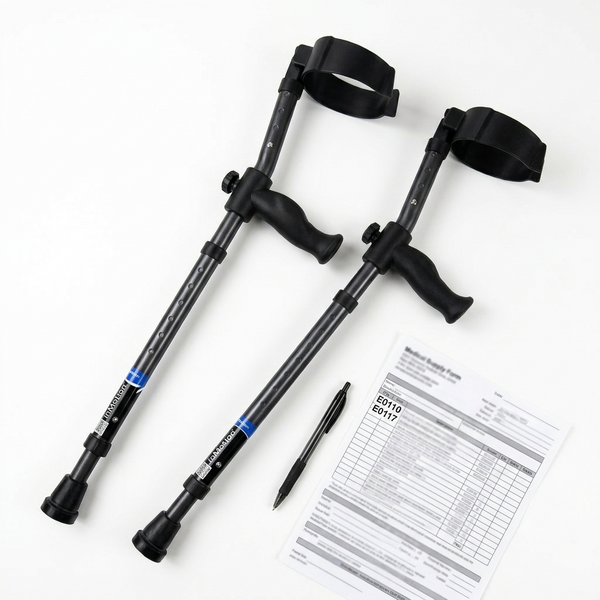
E0110 covers forearm crutches, the style where the cuff wraps around your forearm. Also called Lofstrand or elbow crutches. The in-Motion Pro Forearm Crutch is billed under E0110.
Important detail: E0110 is priced per individual crutch. A pair is two units. If your provider is ordering for you, they should list quantity as 2.
E0117: underarm, articulating, spring-assisted crutch
E0117 describes an underarm crutch with an articulating spring mechanism. The crutch uses a spring to absorb impact and return energy to the user with each step. This is exactly what the in-Motion Pro Underarm Crutch does, and E0117 is the code that applies to it.
The VA's own fee schedule values E0117 at $382.12 per crutch. So when we say the VA benefit has real dollar value, that's the number. For a pair, that's over $750 worth of coverage.
A quick note on coding: CMS guidelines are clear that spring-assisted crutches should be billed as E0117, not as E1399 (the miscellaneous code). If a provider or billing staff suggests E1399, push back. Miscoding is one of the most common reasons DME claims get rejected.
Other codes you might hear about but don't need
E0114: standard underarm crutches, adjustable. This is the generic hospital-issue code and not what you want.
E0111: forearm crutch (general). E0110 is the correct code for in-Motion forearm crutches.
E0116: replacement tip, per crutch.
E0118: crutch substitute. A completely different device. Not crutches.
E1399: miscellaneous DME. Never use this for in-Motion crutches. Wrong code, will likely cause a denial.
The part veterans really need to understand: VA and Medicare are different
This is important and it trips a lot of people up.
Medicare has a Local Coverage Determination, an official policy document, that specifically says E0117 claims will be denied. The exact language is that the medical necessity for a spring-assisted, articulating underarm crutch has not been established. So if you're on Medicare alone and you try to get in-Motion underarm crutches covered, Medicare will likely say no.
But the VA is not Medicare. The VA covers crutches through its Prosthetic and Sensory Aids Service under a completely different framework. The VA doesn't use that same exclusion. Veterans go through the VA and receive in-Motion crutches under E0117 regularly.
VA benefits cover E0117. Medicare usually doesn't. If someone tells you these crutches aren't covered because of the Medicare policy, that policy does not apply to your VA benefits. If you have TRICARE for Life plus Medicare, confirm your specific situation with TRICARE before assuming coverage.
How to use these codes at your appointment
When you see your provider and ask for in-Motion crutches, give them three things:
- The product name: in-Motion Pro Forearm Crutch or in-Motion Pro Underarm Crutch, by Millennial Medical
- The HCPCS code: E0110 for forearm or E0117 for underarm
- The quantity: 2 units for a standard pair
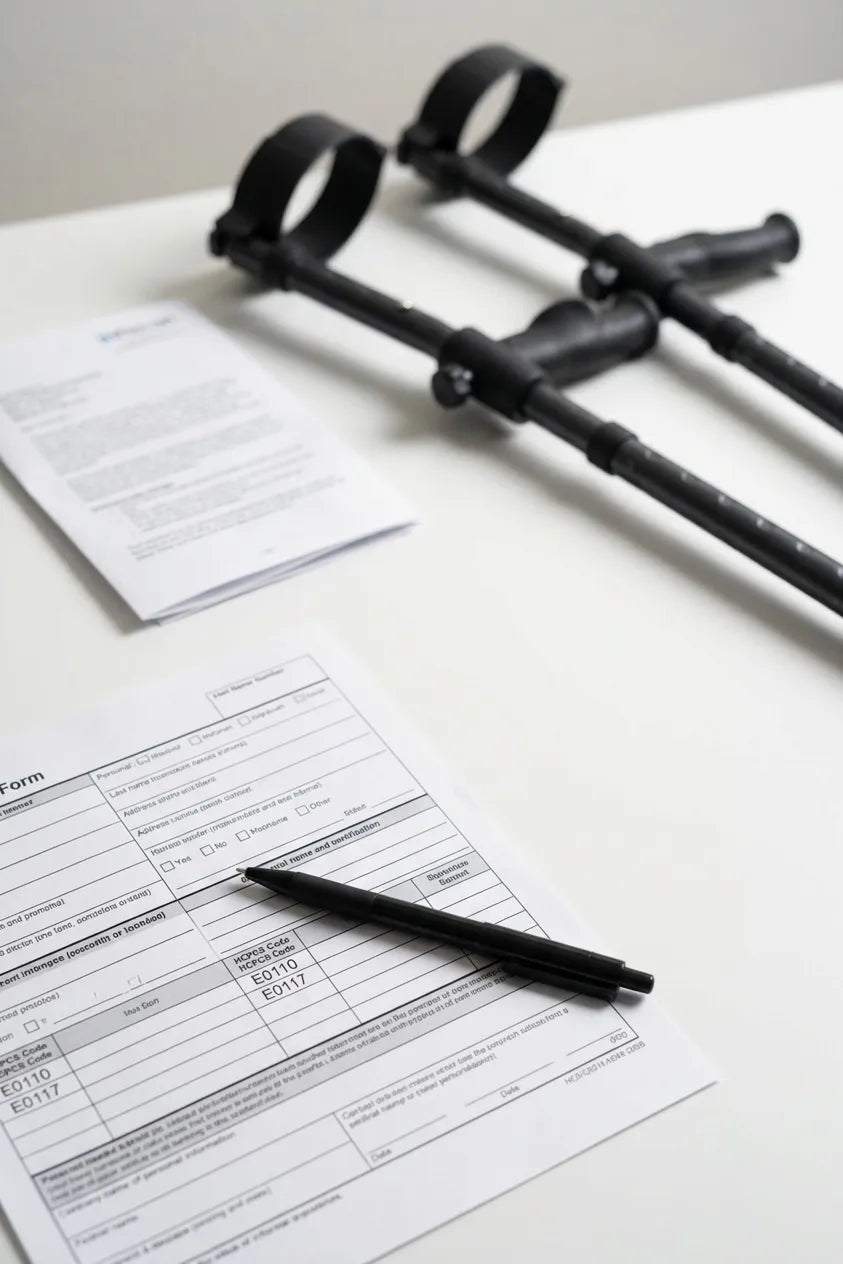
For VA Community Care: ask your provider to put this information in the DME section of VA Form 10-10172 before they submit it. For TRICARE or private insurance: make sure the code is on the prescription itself and verify coverage for that specific code before you accept the equipment.
Free download: Appointment reference sheet
We put together a one-page printable with the product names, HCPCS codes, quantities, and a provider script. Bring it to your appointment so you don't have to remember all of this on the spot.
Download the VA Appointment Reference Sheet (PDF)
Why the code matters more than people realize
Providers work from codes. If a provider writes "crutches" without a specific HCPCS code, the billing system defaults to whatever generic code the facility maps to that word. That's usually E0114, the standard underarm crutch. You get a generic pair and your request for something better gets lost in the process.
Giving your provider the specific code locks in your request. It makes the difference between getting what you asked for and getting the default.
More questions about reimbursement? We have a dedicated insurance reimbursement guide at millennialmedical.com.
Be kind. Be generous. Always pay it forward.
More in the Veterans Series
All six posts in this series are linked below. They're written to stand alone, but they work best together.
- Post 1 of 6: Does the VA Cover Crutches? Yes, Here's Exactly How It Works
- Post 2 of 6: How to Get the Crutches You Actually Want Through the VA
- Post 3 of 6: TRICARE vs. VA Benefits for Crutches: A Straight Comparison
- Post 4 of 6: HCPCS Codes E0117 and E0110: What Veterans Need to Know (this post)
- Post 5 of 6: Getting Crutches Through the VA Community Care Network
- Post 6 of 6: The Best Crutches for Veterans and Why Standard-Issue Falls Short
All posts are also available on our Veterans hub page.
This guide is part of our VA Benefits Crutches Resource Hub, where you'll find every option for getting crutches covered.