Resource Center — Veteran Info
How to Get the Crutches You Actually Want Through the VA
Knowing your VA benefits cover crutches is the easy part. The harder part is walking out of a provider appointment with the specific crutches you asked for instead of the hospital-issue aluminum pair that's been in a closet since 2003.
This post is about the practical stuff: what to say, what form matters, what codes to bring, and what to do if you hit a wall.
Why the default crutch isn't good enough
When a VA provider writes "crutches" on a prescription and doesn't specify anything else, the system fills in the blank with whatever their Prosthetics department has on contract. That's almost always a basic aluminum pair with a flat rubber tip, a rigid handgrip, and no shock absorption.
For two weeks of use after a sprained ankle, that's probably fine. But a lot of veterans are on crutches for months: recovering from knee replacement, managing a long-term hip condition, or dealing with lower extremity injuries from years of service. Standard crutches weren't built for that. They cause wrist problems, nerve pain, and they just flat-out wear you down.
The good news is you're not stuck with the default. The VA's system lets you request specific equipment. You just have to know how to ask.
The form that actually matters: VA Form 10-10172
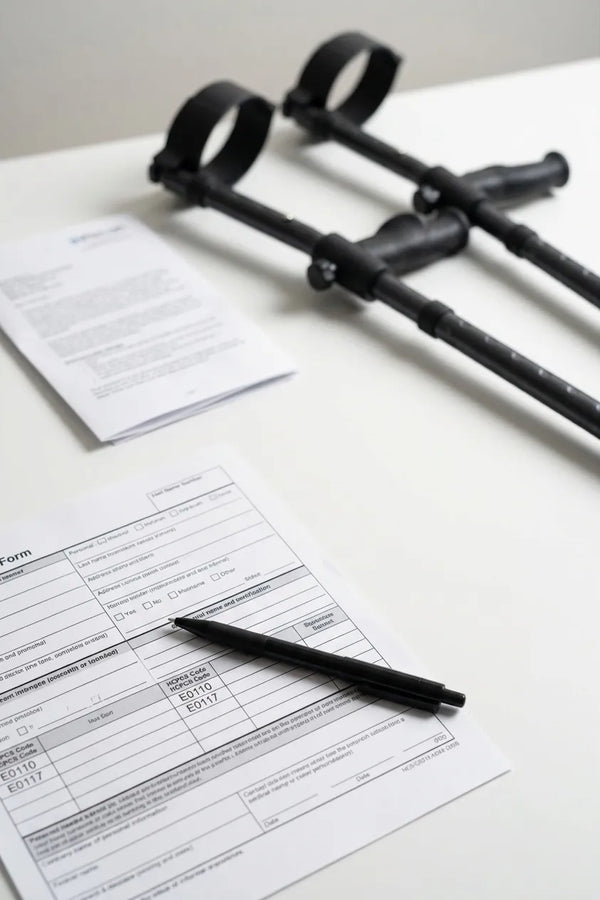
When you see a community provider through the VA and they determine you need crutches, they fill out VA Form 10-10172: the Community Care Provider Request for Service form. This is what kicks off the entire DME process.
The form has a specific section for DME. That section asks for the brand, model, and HCPCS billing code. If your provider fills in "in-Motion crutches by Millennial Medical" along with the right code, that's what gets ordered. If they leave it blank, you get whatever's generic.
Your job at the appointment is simple: make sure your provider has the brand name and billing code before they fill out the form. Everything else follows from that.
The billing codes: just two to remember
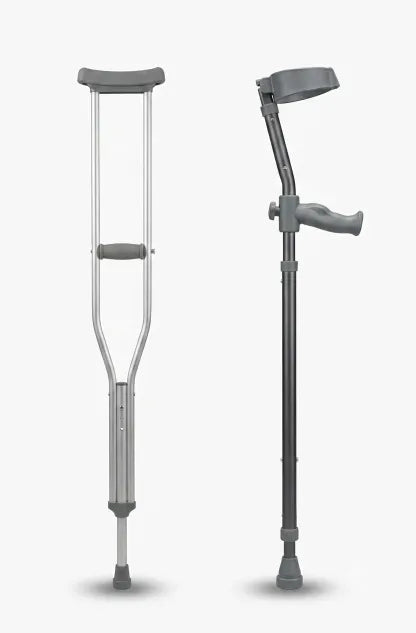
E0110: forearm (Lofstrand) crutches. This is the in-Motion Pro Forearm Crutch.
E0117: underarm, articulating, spring-assisted crutch. This is the in-Motion Pro Underarm Crutch.
These codes are priced per crutch, so a pair is 2 units. Just a heads up if your provider asks.
What to say at your appointment, word for word
Doctors are busy. They don't always have time to research specific products. The easiest thing you can do is tell them exactly what you want and hand them the information they need.
"I'd like to be prescribed in-Motion crutches made by Millennial Medical. They're FDA-cleared. The HCPCS code is E0110 for the forearm model or E0117 for the underarm model. I understand they're covered under my VA DME benefits, and I'd appreciate you listing the brand and model on the Request for Service form."
That's it. You're not asking for anything unusual. You're giving them the specific information they need to fill out one field on a form correctly.
Two situations, two different processes
Planned situations: surgery coming up, managing a chronic condition
This is the routine path. Your provider fills out the form, submits it to your VA Medical Center's community care office within 24 hours, and PSAS coordinates fulfillment from there. You don't get the crutches on the spot. Make sure your brand request is on that form before it leaves your provider's office.
Urgent situations: being discharged after surgery, or in the ER
Different rules here. In an urgent situation, your provider can hand you crutches before you walk out the door with no pre-authorization from the VA needed. TriWest reimburses them directly. If you're in that situation, ask for in-Motion by name right then.
Note: The VA is clear about this, failing to plan ahead for a scheduled procedure doesn't make it an urgent situation. The urgent pathway is for genuine emergencies, not a shortcut around the routine process.
Tips that will actually help
- Print out the product name and HCPCS codes and bring them with you. Hand them to the provider when you ask.
- If you're seeing a community provider, confirm before your appointment that they're in the VA Community Care Network.
- Call your local VAMC's Prosthetics department directly. They deal with this every day.
- If you get stuck, call the VA's IVC National Contact Center: 877-881-7618. Press 1 for veterans. Available Monday–Friday, 8am–9pm Eastern.
- If your request gets denied or substituted, ask your provider to resubmit with a stronger medical necessity statement.
Free download: What to bring to your appointment
We put together a one-page reference sheet you can print and bring with you. It includes the product name, billing codes, the provider script, and a quick checklist.
Download the VA Appointment Reference Sheet (PDF)
Still not getting anywhere?
Call us. Millennial Medical is a small company and we'll actually help you navigate this. You can reach us at millennialmedical.com.
Be kind. Be generous. Always pay it forward.
More in the Veterans Series
All six posts in this series are linked below. They're written to stand alone, but they work best together.
- Post 1 of 6: Does the VA Cover Crutches? Yes, Here's Exactly How It Works
- Post 2 of 6: How to Get the Crutches You Actually Want Through the VA (this post)
- Post 3 of 6: TRICARE vs. VA Benefits for Crutches: A Straight Comparison
- Post 4 of 6: HCPCS Codes E0117 and E0110: What Veterans Need to Know
- Post 5 of 6: Getting Crutches Through the VA Community Care Network
- Post 6 of 6: The Best Crutches for Veterans and Why Standard-Issue Falls Short
All posts are also available on our Veterans hub page.
This guide is part of our VA Benefits Crutches Resource Hub, where you'll find every option for getting crutches covered.