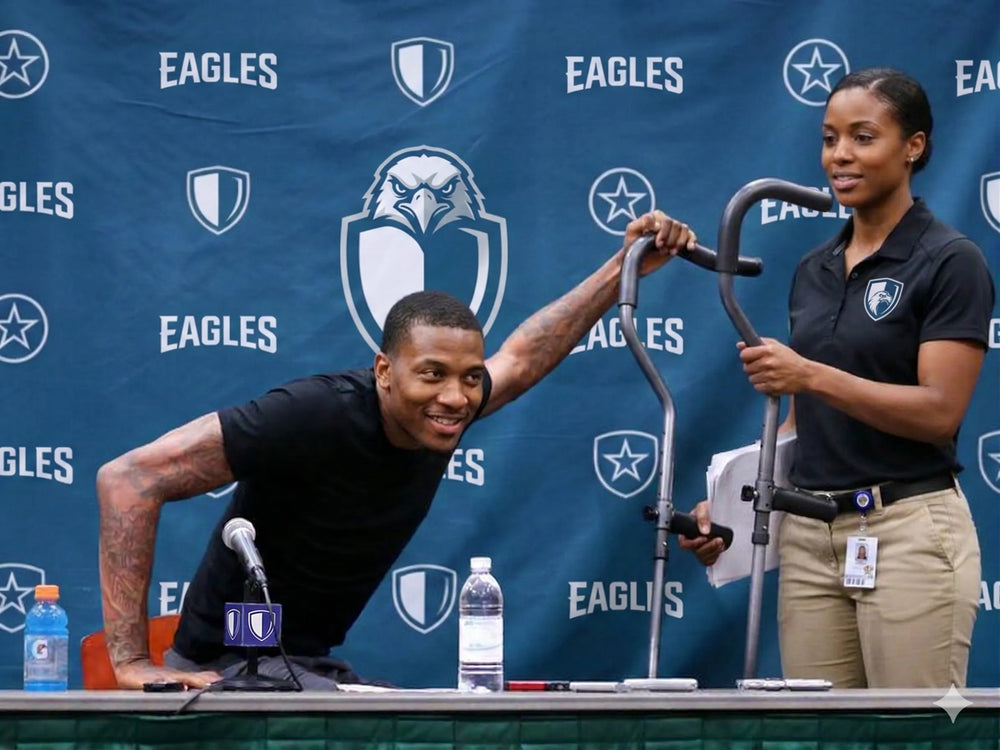
Smiling athlete with crutches at press conference

Resource CenterMedical Solutions

Medical Solutions

The Best Crutches for Tall People: What to Look For

If you're above average height and you've ever tried to use standard crutches, you already know the problem. You adjust them to the highest setting. You're still hunched. Your wrists are bent at an awkward angle. Your shoulders are creeping up toward your ears. And within an hour, everything hurts, not from your injury, but from the equipment. This isn't a minor inconvenience. Using crutches that are too short forces your entire body into a compensatory posture that strains your back, neck, shoulders, and wrists simultaneously. For tall users, "standard" crutches aren't just uncomfortable, they can actively make recovery harder. Here's what to actually look for. Why Most Crutches Don't Work for Tall People The medical equipment industry has historically designed for the middle of the bell curve. Most standard crutches are built to accommodate users up to around 6'0" maybe 6'6" at a stretch. For anyone taller than that, the options have traditionally been limited, expensive, or both. The problem goes beyond just height adjustment range. Even crutches that technically reach the right height often lack:
  • Enough handle adjustment range to properly position the grip for a tall user's arm length
  • Sufficient structural strength to handle the leverage forces created by a longer frame
  • Adequate underarm cradle positioning that keeps a taller user's weight properly distributed
The result is a product that technically fits on paper but fails in practice, leaving tall users in discomfort and, in some cases, at risk of the crutch failing under load. What to Look for When You're Tall Height range that actually covers you This sounds obvious, but it's worth being specific. Look for crutches that extend to at least 62–63 inches from floor to underarm cradle. That covers users up to roughly 6'6" comfortably. If you're taller than that, look specifically for an "extended" or "tall" version.  These exist, but you won't find them at a pharmacy. Millennial Medical's In-Motion Pro Underarm Crutch extends from 50 to 62.5 inches in 13 height positions, comfortably fitting users up to 7'1". That's a meaningful difference from the standard 6'6" ceiling most crutches impose. Multiple adjustment points not just overall height A crutch that only adjusts at the base doesn't give you enough control over fit. Look for crutches with separate adjustments for overall height and handle position. This lets you dial in the grip height independently, which is critical for getting the correct wrist angle regardless of your exact proportions. Weight capacity that doesn't make you nervous Taller people are generally heavier, and crutches that list a 250 or 300 lb. capacity leave little margin for someone who's 6'4" and 220 lbs. moving dynamically through a gait cycle. Look for a minimum 350 lb. capacity. Millennial Medical crutches support up to 350 lbs. load-tested for real-world use, not just static weight. Spring-assist or shock absorption This matters for everyone, but especially for tall users. The longer your frame, the more leverage force gets transmitted through the crutch tips with every step. A rigid crutch transfers all of that directly into your hands and wrists. Spring-assisted crutches absorb and redistribute that impact, which makes a significant difference over the course of a full day of use. Ergonomic grip design Standard crutch handles are flat and straight, designed without regard for wrist alignment. For tall users who are often gripping at an awkward angle due to improper fit, an ergonomic angled grip can be the difference between manageable discomfort and real wrist pain. Look for grips that position the hand at a slight downward angle to keep the wrist bones naturally aligned. Underarm vs. Forearm Crutches for Tall Users Both styles are available in tall versions, and both have advantages depending on your situation. Underarm crutches are generally easier to learn and better for shorter recovery periods. For tall users, the key is finding a model with a wide enough underarm cradle that distributes weight across the chest wall rather than digging into a narrow area, which is more pronounced the taller you are. Forearm crutches eliminate the underarm pressure issue entirely by shifting weight to the forearms and hands. For tall users dealing with longer recoveries or chronic conditions, forearm crutches are often the more comfortable long-term option. They also tend to be more maneuverable, which matters when you're navigating spaces that weren't designed with a 6'4" person on crutches in mind. A Note on Where You Buy Standard pharmacies and big box stores carry a narrow range of crutch sizes, typically designed for the average population. If you're tall, you're unlikely to find what you need off a pharmacy shelf. Buying directly from a specialty manufacturer gives you access to extended sizing, proper weight ratings, and the kind of customer support that can actually help you get fitted correctly. At Millennial Medical, we've helped users up to 7'1" find the right fit, something no pharmacy shelf is going to do. Shop Crutches For Tall People The Bottom Line If you're tall and you've struggled with standard crutches, the problem isn't you, it's the equipment. The right crutch for a tall user needs an extended height range, independent handle adjustment, adequate weight capacity, and ideally some form of shock absorption to manage the increased leverage forces involved. Don't settle for the highest setting on a standard crutch and hope for the best. The right fit exists, and it makes a bigger difference than most people expect.   Be kind. Be generous. Always pay it forward.   Support for Life’s Adventures