Resource Center — Medical Solutions
Pre-Op Patient Education: How to Reduce Crutch-Related Callbacks
Every orthopedic practice has a callback log. The calls don't make headlines: "My shoulders are killing me." "When can I shower?" "How do I go up the stairs?" "Is it normal that my hands are numb?" "Can I take the boot off to sleep?"
They're routine, predictable, and almost universally avoidable.
They're also expensive. Every callback costs five to fifteen minutes of clinical staff time. Every avoidable office visit burns an appointment slot that could have gone to a new consult. Every escalation, a fall, a re-rupture, a wound complication, a DVT call to the ER, represents a patient who left for home without the information they needed to get through the first weeks safely.
The single highest-return intervention for reducing post-op call volume isn't a new app, a new portal, or a new staffing model. It's pre-op education. Patients who walk into surgery with a clear, concrete picture of what the next six weeks at home will look like generate fewer calls, miss fewer appointments, follow protocols more consistently, and return to function faster.
This post is for clinicians, surgery center coordinators, and PTs who are designing or refining their pre-op education process. It covers the crutch-related callback categories that pre-op education most reliably reduces, the topics that actually move the needle, and a practical framework for fitting updated patient education into existing pre-op workflows.
Why Crutch-Related Callbacks Are an Undertreated KPI
Most orthopedic practices track surgical volume, complication rates, and patient satisfaction scores. Few track post-op call volume systematically, and even fewer break it down by call category. But call volume is one of the cleanest leading indicators of how well pre-op education is working.
The most commonly reported call categories in the first six weeks after lower-extremity orthopedic surgery cluster into a predictable pattern:
- Crutch fitting and use, height adjustment, hand grip placement, shoulder pain, wrist pain, hand numbness
- Mobility technique, stair use, getting in and out of bed, getting in and out of cars, transferring on and off toilets
- Boot, brace, or splint compliance questions, when to wear, when to remove, sleeping protocols, showering protocols
- Weight-bearing protocol clarification, NWB vs. TDWB vs. PWB vs. WBAT, and what each actually means at home
- Driving and return-to-work questions
- Pain management questions that should have been in the discharge packet
- Falls, near-falls, and general fall-risk anxiety
- When to call vs. when to wait
Every one of those categories is reducible through pre-op education. Most are reducible by 50% or more with focused effort.
What Pre-Op Education Most Reliably Reduces Callbacks About
Not all pre-op education is equally effective. The topics with the most operational value share three things: they're concrete rather than abstract, they're visual or demonstration-based rather than text-only, and they're reinforced across multiple touchpoints rather than delivered once and forgotten.
1. Crutch Fitting and Basic Use Technique
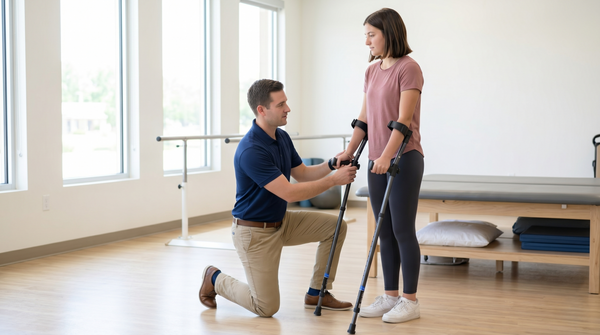
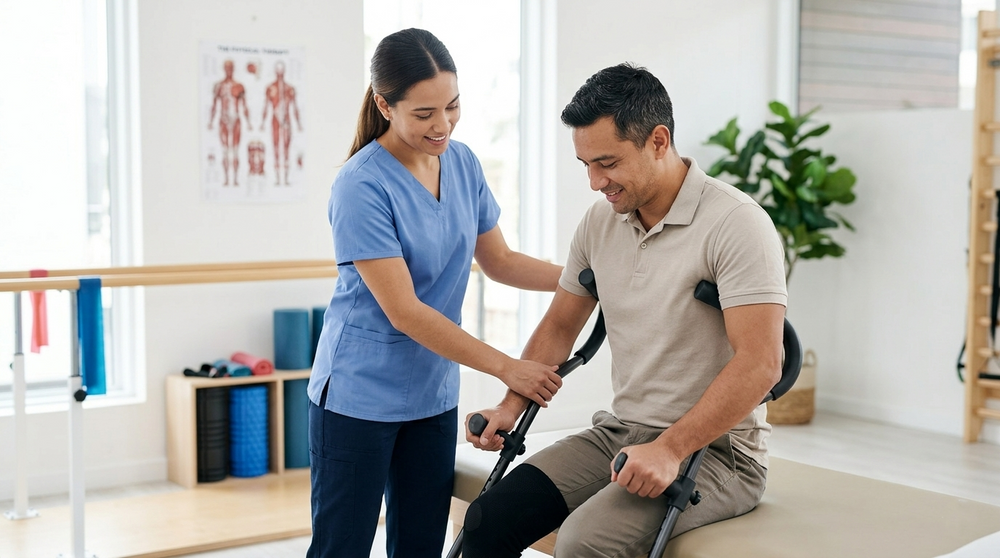
The single largest source of crutch-related callbacks is patients using poorly-fit crutches incorrectly. Hand grip too high or too low. Underarm pads bearing weight that should be supported by the hands. Stride length that's too short or too long. A 60-second video, a printed handout with diagrams, and a brief in-person demonstration at the pre-op visit will cut the volume of "my shoulders hurt" and "my hands are numb" calls in week one, dramatically.
2. Stair Technique
"Up with the good, down with the bad." Patients who learn this before surgery, ideally with a brief practical demo, handle stairs more safely and call less often. Stair-related falls are among the highest-stakes complications of those first weeks at home. It's a simple phrase. It's worth repeating until it sticks.
3. Concrete Weight-Bearing Language
Patients routinely conflate non-weight-bearing (NWB), touch-down weight-bearing (TDWB), partial weight-bearing (PWB), and weight-bearing as tolerated (WBAT). Each is a different prescription with different practical implications. Plain-language explanations work better than acronyms. "TDWB means as much weight as a postage stamp, just for balance" is something a patient can hold onto. The clinical shorthand is not.
4. Home Setup Before Surgery, Not After
Patients who arrive home to a recliner, raised toilet seat, shower chair, cleared pathways, and pre-cooked meals fall less, call less, and recover faster. A pre-op handout listing the specific home modifications that matter for their procedure, not a generic "prepare your home" blurb, is one of the most valuable pieces of patient education a practice can produce. And it costs almost nothing to create.
5. The First 72 Hours
Most calls in the first three days are predictable: pain management questions, swelling concerns, nausea, when to take the next dose, how to ice. A short, dated post-op timeline, "Hours 0–12, 12–24, Day 2, Day 3", given to the patient before surgery tells them what to expect at each stage. It doesn't eliminate all calls. But it cuts the "is this normal?" volume substantially.
6. When to Call vs. When to Wait
Patients call the office for two reasons: they're worried, or they want permission to do something. A clear "call the office immediately if…" list handles the first. A "you don't need to call us about…" list handles the second. Together, they reduce inbound call volume without any reduction in clinical safety. Both lists should be visible, not buried at the back of a packet nobody reads past page two.
A Practical Pre-Op Education Framework
The most effective pre-op education is spread across multiple touchpoints rather than crammed into one appointment. Patients retain about 20% of what they hear in a verbal briefing. And most of what they do absorb at the pre-op visit is competing with anxiety about the surgery itself.
Two weeks before surgery:
- Mailed or emailed packet with a procedure-specific recovery timeline, a home setup checklist, and links to patient education content
- Optional: a short pre-op video (5–10 minutes) covering crutch use, stair technique, home setup, and what to expect in the first 72 hours
At the pre-op visit:
- Brief in-person crutch demonstration, fit them, hand them the crutches, watch them take ten steps
- Stair technique demonstration if a model is available
- Hand the patient a one-page "first 72 hours" timeline to take home
- Confirm they have a ride and someone with them for the first 24–48 hours
Day of surgery / discharge:
- Discharge packet with the same materials they've already seen, this is reinforcement, not first exposure
- A clearly visible "call the office if…" list at the top of the packet
- Phone number and after-hours protocol on every page, not just the back
Post-op follow-up call (24–48 hours):
- A brief structured call from a nurse or coordinator: pain level, are they using the crutches correctly, are they following the weight-bearing protocol, any questions
- This one call captures the majority of questions that would otherwise become inbound calls on days 3–7
The Crutches Themselves Are a Callback-Reduction Lever
In the practices we work with most closely, a meaningful share of "crutch-related" callbacks aren't about technique at all. They're about the crutches. Patients calling about shoulder strain, hand numbness, wrist pain, or upper-body fatigue in weeks two or three aren't doing anything wrong. They're using standard underarm crutches that haven't changed materially in 70 years, equipment that wasn't designed for the kind of sustained daily use modern recovery protocols require.
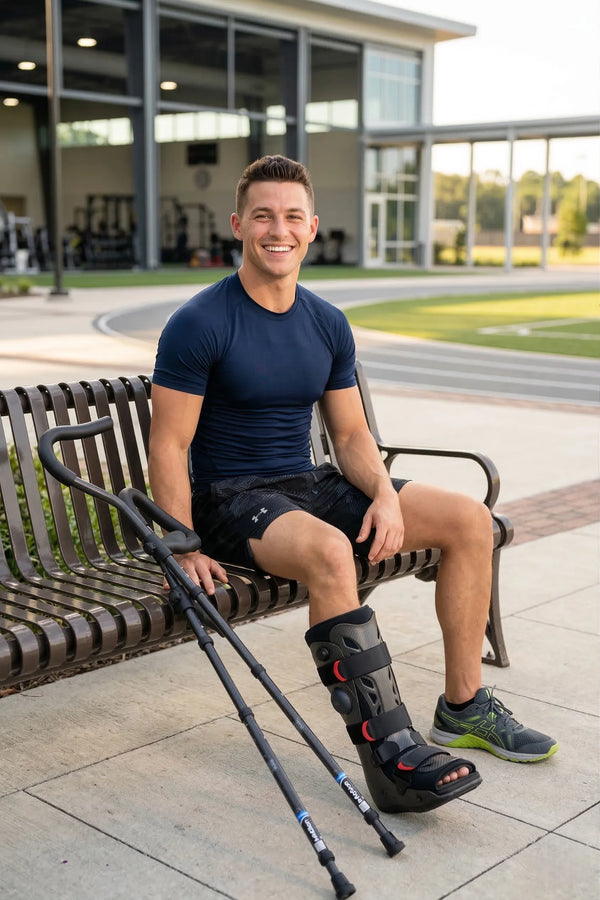
This is most relevant for surgeries with longer crutch windows: meniscus repair, foot and ankle, ACL with concurrent meniscus, and Achilles repair. A patient facing four to twelve weeks of daily crutch use will develop secondary symptoms by weeks two or three. That's not a minor inconvenience, it's the leading reason patients break protocol and start hopping or weight-bearing prematurely. Which is when you get the call you really don't want.
The In-Motion crutch was designed specifically to address the cumulative-load problem in extended crutch use. The spring-assist mechanism absorbs impact before it reaches the joints, reducing the load on hands, wrists, and shoulders with every step. That design came out of three years of development and a review of 34 medical studies on crutch-related strain. For practices that see measurable post-op call volume from crutch-related secondary symptoms, the equipment itself is an operational lever, not just a product decision.
Learn more about clinician partnerships and the In-Motion crutch →
Patient-Facing Resources You Can Use
We've published a six-post surgery recovery hub, patient-facing guides built to support pre-op education across the surgeries with the most demanding crutch phases. Each covers realistic timelines, weight-bearing protocols, home setup, when to call, and the decisions that determine whether the recovery goes well. They're written for patients but designed to be share-ready as part of your pre-op education materials. Link to them from your patient portal, include the URLs in pre-op packets, or reference them in patient education videos, whatever fits your workflow.
- How to Use Crutches After ACL Surgery: A Complete Recovery Guide
- How to Use Crutches After Hip Replacement Surgery: A Complete Recovery Guide
- How to Use Crutches After Meniscus Surgery: A Complete Recovery Guide
- Knee Replacement Recovery: A Patient's Guide to the Crutch Phase
- Foot & Ankle Surgery: Your Complete Crutch Recovery Guide
- Achilles Tendon Repair: The Non-Weight-Bearing Phase, Explained
The Bottom Line
Crutch-related callbacks are not a fixed cost of orthopedic practice. They're a measurable, reducible signal of the gap between what patients know going into surgery and what they actually need to know once they're home.
The practices with the lowest call volumes aren't the ones with the most stoic patients. They're the ones with the most thorough, repeated, concrete pre-op education.
A pre-op education process built around the categories above, crutch fitting, stair technique, weight-bearing language, home setup, the first 72 hours, when to call, routinely cuts post-op call volume by half or more in the practices that adopt it. The patients are clearer on what to expect, the staff gets fewer interruptions, and the protocols actually get followed.
The investment is small relative to the return. And it's one of the few areas in orthopedic operations where doing the right thing for patients and doing the right thing for the practice point in exactly the same direction.