Resource Center — Medical Solutions
The Clinical Case for Ergonomic Crutches: What the Research Says
Ask most clinicians why they prescribe a particular crutch and the honest answer is usually some version of "it’s what the DME company sends." Conventional axillary crutches are the default in most US hospitals not because the literature supports them as the optimal choice, but because they’re cheap, broadly available, and what most providers used during training. The choice is rarely revisited.
That status quo doesn’t hold up well against the research. Decades of biomechanics, occupational injury, and rehabilitation literature have documented specific patterns of harm associated with prolonged use of conventional crutches. Patterns that aren’t artifacts of poor patient compliance and that show up reliably across patient populations. The ergonomic and spring-assist crutch designs that have entered the market over the last 15 years exist because the research identified problems the conventional designs do not solve.
This post summarizes the clinical case. It’s written for clinicians, not as a marketing argument, but as a synthesis of where the literature actually points. It covers the three best-documented harms of conventional crutches, the energy and gait considerations that affect recovery quality, the patient-compliance question, and what the research suggests an ergonomic alternative needs to do to clear the bar.
Where the Research Is Most Settled
Three areas of harm associated with prolonged conventional crutch use are well-established in the orthopedic and rehabilitation literature. None of them are controversial within the field. All three are routinely under-discussed in patient education and almost never factored into DME prescribing decisions.
1. Median Nerve Compression and Upper-Extremity Soft-Tissue Injury
Conventional axillary and forearm crutches concentrate body weight onto small contact areas on the palm and wrist. The biomechanics are well-characterized. With each step, the weight transfer from the legs through the hands generates pressures that, over hundreds of repetitions per day, produce predictable injury patterns. The literature documents elevated rates of:
- Median nerve compression at the wrist (the mechanism underlying carpal tunnel symptoms), with measurable changes on nerve conduction studies in patients using conventional crutches for 4+ weeks
- De Quervain’s tenosynovitis and other thumb-base tendinopathies, particularly in patients gripping handles tightly to compensate for under-supported axillary crutches
- Hand and forearm bruising, blistering, and skin breakdown, especially in elderly patients or those with thin skin
- Persistent post-recovery wrist and hand symptoms in some patients. A meaningful share of crutch users report symptoms that outlast the underlying lower-extremity recovery.
These outcomes are not caused by misuse. They are caused by the design, specifically the absence of any meaningful impact-absorption between the floor strike and the hand. Every step transmits a force spike directly to the upper extremity. Studies measuring peak hand-grip force during conventional crutch ambulation report values that, multiplied across an average daily step count, exceed established occupational ergonomic thresholds for cumulative wrist loading.
2. Axillary Neuropathy ("Crutch Palsy")
This one is older and arguably better documented than the wrist literature. Axillary crutches that bear weight in the armpit, even briefly, even when patients have been told not to, produce a recognized syndrome of brachial plexus and axillary nerve compression often called "crutch palsy." Symptoms include:
- Sensory disturbance and weakness in the affected upper extremity
- Wrist drop in more severe cases
- Persistent numbness or paresthesias that can outlast crutch use by weeks or months
- In rare cases, permanent neurological deficit
The clinical guidance taught in nursing schools and PT programs is universally to avoid weight-bearing in the axilla. The clinical reality, observed in any hospital floor or post-op patient population, is that patients rest in the axilla constantly. When they’re tired, when they’re standing in line, when they’re talking to the nurse, when they think they’re using the crutches correctly but lose form for 30 seconds at a time. The instruction "don’t lean into the axilla" is not a reliable safeguard. Patients who use axillary crutches for more than 1 to 2 weeks are routinely observed loading the axilla regardless of instruction. The neuropathy literature reflects that observation.
3. Shoulder, Rotator Cuff, and Cervical-Spine Loading
Less catastrophic than crutch palsy but more common: the cumulative shoulder load of conventional crutch ambulation produces measurable upper-quarter musculoskeletal complaints in a substantial percentage of long-term users. The shoulder is being asked to do something it’s not anatomically optimized for, repeatedly bear and transmit body weight at the end-range of glenohumeral mechanics. The cumulative effect over weeks of use shows up as rotator cuff irritation, periscapular muscle dysfunction, and cervical-spine complaints, particularly in older patients and those with pre-existing shoulder pathology.
This is the load profile the spring-assist concept was developed to address. By absorbing impact at the ground-strike phase, the upper-extremity force spike is meaningfully reduced. Over thousands of steps per week, the cumulative load delta becomes clinically significant.
The Energy Expenditure Problem
Crutch walking is metabolically expensive. The classical literature, going back to studies in the 1970s and replicated multiple times since, documents that conventional crutch ambulation requires approximately 2 to 3 times the energy expenditure of normal walking at equivalent speeds. The implications are clinically meaningful for several patient populations:
- Older patients with cardiopulmonary comorbidities are sometimes unable to ambulate the distances they need to (to the bathroom, to PT appointments, to the kitchen) on conventional crutches without dyspnea
- Deconditioned patients have higher baseline fatigue and lower activity tolerance, leading to less ambulation and slower recovery
- Patients with high BMI face elevated upper-body load and elevated energy demand simultaneously, with predictably worse compliance and outcomes
- All patients accumulate fatigue across a recovery day in ways that affect later activities, including PT participation, household activities, and sleep quality
Reducing the per-step energy cost of crutch ambulation is not a luxury feature. It expands the population of patients who can actually meet the activity targets surgeons and PTs are trying to set.
Gait Deviations and the Question of Functional Recovery
Conventional crutch use produces a characteristic compensatory gait. Short stride length, asymmetric weight transfer, shoulder elevation, and trunk lean. PTs spend substantial portions of post-op rehab trying to correct it. Some of this is unavoidable on any crutch design, but the magnitude of compensation correlates with how much the crutch design fights the patient’s natural gait mechanics.
Two specific patterns are worth attention. First, the crutch-induced "hiking" gait, where the patient elevates the operated leg via hip-and-pelvis hike rather than knee flexion, reinforces movement patterns that have to be unwound in PT once weight-bearing is restored. Patients who spend 6 weeks on conventional crutches with significant gait compensation often arrive at PT with motor patterns that take additional sessions to correct.
Second, the asymmetric upper-body load on conventional crutches affects trunk and pelvic stability in ways that compound for patients with concurrent lumbar pathology. The post-op patient with longstanding low-back pain who comes off crutches with a flared lumbar spine is a common clinical presentation, and one that reduces over the patient population on ergonomic crutches with more symmetric load profiles.
The Patient Compliance Question
There’s a quiet variable in every recovery outcome that doesn’t show up in the typical clinical literature: patients who hate their crutches use them less. They sit when they should be moving. They skip the gentle ambulation surgeons and PTs are recommending. They take shorter routes around the house instead of the longer ones that would build conditioning. They schedule PT sessions less aggressively because the crutch part of the appointment is unpleasant.
None of this shows up in a randomized controlled trial. All of it shows up in real-world recovery quality. The patient-reported-outcome literature, where it exists for crutch comparison, consistently shows higher comfort scores, higher self-reported activity levels, and higher overall satisfaction for ergonomic and spring-assist designs over conventional axillary crutches. Effects that, in clinical practice, translate to better patient adherence to recovery protocols.
The most convincing evidence for ergonomic crutch designs is not a single biomechanics paper. It’s the consistency of patient-reported outcome data across procedure types, patient populations, and study designs. Patients who use ergonomic crutches do more recovery activity, report less pain, and complete protocols more reliably. That’s the outcome variable surgeons and PTs actually care about.
What Ergonomic Crutches Have to Do to Clear the Bar
Several products have entered the ergonomic-crutch category over the last 15 years with varying levels of biomechanical justification. From the clinical literature, the design features that map to documented harm reduction are:
- Impact absorption at the ground strike. Cuts the peak force spike transmitted to the upper extremity. The single most clinically significant feature.
- Symmetric weight distribution across the hand and forearm. Reduces concentrated pressure on the median nerve and thumb-base tendons.
- No axillary contact. Eliminates the crutch-palsy mechanism entirely. Forearm-supported designs are inherently safer than axillary designs for any use longer than 1 to 2 weeks.
- Lower per-step energy cost. Spring-assist designs return some of the impact energy to the next step, reducing the metabolic cost of ambulation.
- Stable, well-distributed shoulder load. Reduces the cumulative rotator cuff and cervical-spine loading associated with extended use.
- Patient-reported comfort. The downstream variable that drives compliance, activity tolerance, and recovery quality.
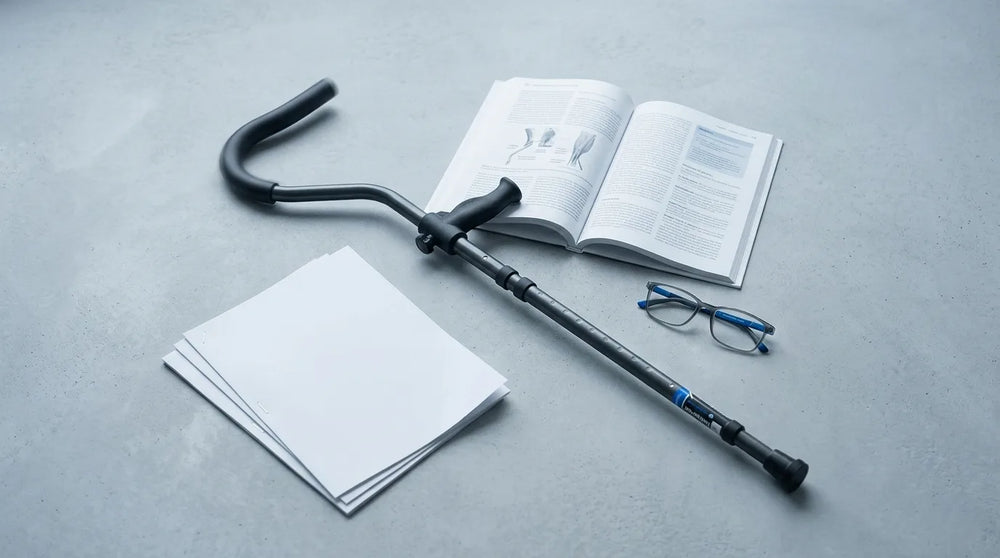
The In-Motion crutch was developed against this list. Three years of product development, including a review of 34 medical studies on crutch-related injury and biomechanics, informed a spring-assist design that addresses each of these targets. We’re not the only product in the ergonomic crutch category, and we’re not claiming exclusivity on the underlying clinical case. We are claiming that the underlying clinical case is settled enough to justify revisiting the conventional-crutch default in any practice that prescribes crutches for 4+ week use windows.
Implications for Practice
None of the above is meant to suggest that conventional crutches should never be prescribed. For acute, short-duration use (a sprained ankle being sent home from the ED, a 5-day post-op window before transition off crutches), conventional axillary crutches are fast, cheap, and adequate. The clinical case for the ergonomic alternative is specifically about prolonged use. Any procedure expected to require crutches for more than 2 to 3 weeks.
That covers a substantial share of orthopedic surgical volume. Total joint replacements, ACL reconstructions, meniscal repairs, foot and ankle surgeries with hardware, Achilles repairs, and tibial plateau fractures all routinely involve crutch protocols of 4 to 12 weeks or longer. For these procedures, the cumulative-load and compliance literature points clearly enough that the prescribing question deserves to be revisited at the practice or hospital level.
Three practical questions to consider:
- Does your DME prescribing protocol distinguish between short-duration and long-duration crutch use? Most don’t.
- Does your patient education flow include guidance on what to expect from upper-extremity load, and signs to escalate (numbness, persistent wrist pain, weakness)? Most don’t.
- Have you priced the actual cost differential between conventional and ergonomic crutches, factoring in the rotator cuff, carpal tunnel, and PT-time cost of cumulative-load complications? Most haven’t.
These are not marketing questions. They are operational questions that have a meaningful clinical answer if you sit down with the literature.
A Fair Concession on the Limits of the Evidence
The strongest version of this case is what we’ve made above. The fair concession is that the head-to-head randomized controlled trial literature comparing ergonomic to conventional crutches across procedure types is thinner than the broader biomechanics literature suggests it should be. The harms-of-conventional-crutches research is robust. The direct comparative-effectiveness research, while consistent in direction, is smaller than what would be ideal.
That’s an honest gap. We expect the comparative literature to grow over the next decade as ergonomic crutches become more common in clinical practice. In the meantime, the indirect evidence (biomechanics, energy expenditure, neuropathy literature, and patient-reported outcomes) supports a coherent case that we don’t think requires waiting for a definitive RCT to act on.
The Bottom Line
Conventional axillary crutches are the default in US clinical practice not because the research supports them as the best choice, but because they’re cheap and familiar. The literature on cumulative upper-extremity load, median nerve compression, axillary neuropathy, energy expenditure, and patient compliance points consistently toward ergonomic alternatives for any procedure with a crutch protocol longer than 2 to 3 weeks.
The clinical case is not exotic. It’s the same kind of cumulative-load reasoning that has driven changes in surgical positioning, OR ergonomics, occupational health, and dozens of other domains where small per-event loads compound to clinically significant outcomes over time. The interesting question is not whether the case is sound. The interesting question is why the prescribing default has been so slow to update.
Read more about the In-Motion crutch design →
Frequently Asked Questions (Clinician-Oriented)
Are ergonomic crutches reimbursable through Medicare/Medicaid?
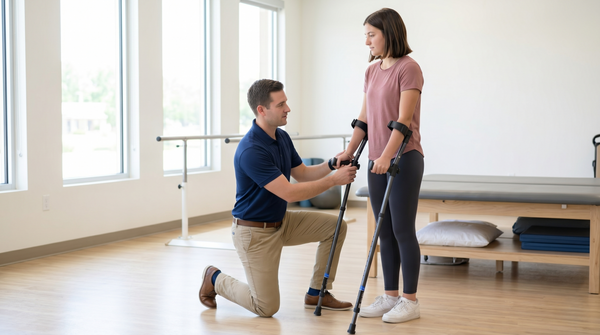
In most cases yes, under the same DME HCPCS codes that cover conventional crutches, specifically the forearm crutch codes (E0117 and similar). Specific reimbursement varies by region and payer. A brief check with your DME billing team will confirm coverage for your specific patient population.
What’s the typical patient adjustment period?
Most patients adjust within 1 to 2 days. The gait pattern is similar enough to conventional forearm crutches that PT-supervised fitting and a brief in-clinic walk-through is usually sufficient. Patients transitioning from conventional axillary crutches typically describe the change as immediate relief in the upper body within the first session.
Are there contraindications?
Severe upper-extremity pathology (active rotator cuff tears under acute repair, severe wrist arthritis, fresh forearm fractures) may make any forearm-supported crutch unsuitable. In those cases, a knee scooter or wheelchair may be a better fit. Cognitive or balance impairments severe enough to make any crutch unsafe are also contraindications. For most ambulatory orthopedic patients, there are no specific contraindications beyond what would apply to conventional forearm crutches.
How does the cost compare to conventional crutches?
Per-unit cost is higher than conventional axillary crutches and comparable to or slightly above conventional forearm crutches. The cost differential should be weighed against the documented incidence of upper-extremity complications and the PT-time cost of unwinding gait compensation. For most surgical practices, the breakeven case is straightforward when those downstream costs are factored in.
Where can I see the underlying research?
The biomechanics, energy expenditure, neuropathy, and patient-reported-outcome literature on crutch use is published across orthopedic, rehabilitation, occupational health, and biomechanics journals. Our internal review covered 34 studies in the product-development phase. We’re happy to share a curated reading list with any clinician who reaches out. Contact information is on the website.
Related Reading
- Pre-Op Patient Education: Reducing Post-Op Callback Volume
- Crutch Fitting for PTs: 7 Common Mistakes That Slow Patient Recovery
- How to Use Crutches After ACL Surgery
- Hip Replacement Recovery