Best Crutches to Buy With FSA or HSA Dollars (2026 Guide)
Your FSA and HSA dollars are pre-tax money. That means when you spend them on crutches, the government is effectively covering 20 to 35 percent of the cost depending on your tax bracket. You are not spending $139. You are spending closer to $105.
The question is not whether to use your FSA or HSA for crutches. The answer to that is obviously yes. The question is which crutches are actually worth those tax-advantaged dollars -- and which ones are just checking a box.
Here is how to make that call well.
At a 22% tax bracket, the in-Motion crutch at $139 has an effective cost of roughly $108. At a 24% bracket, it drops to around $106. If your marginal rate is 32%, you are looking at closer to $95.
That is the number you are actually spending.
What Makes a Crutch "Worth" Your FSA/HSA Dollars
Not every item on an FSA/HSA eligibility list is created equal. Eligibility means the IRS will let you use tax-advantaged money for the purchase. It does not mean the product is good. When it comes to crutches, the things that separate a genuinely useful pair from a waste of pre-tax money are: Ergonomics. How the grip is shaped, how weight is distributed across your hand and wrist, and whether the axillary pad (the armpit piece on underarm crutches) is positioned and padded properly. Poor ergonomics cause secondary injuries. Good ergonomics protect you during recovery. Weight. A heavier crutch means more energy expenditure per step. Over the course of a six-week recovery, that adds up to real fatigue. Adjustability. Your crutch height and handle height need to fit your body precisely. A crutch that cannot be fine-tuned to your proportions will put stress in the wrong places regardless of its other qualities. Secondary injury risk. The most commonly cited crutch-related complications are shoulder impingement, rotator cuff strain, wrist and hand pain, and axillary nerve compression. The right crutch design minimizes all of these. The wrong one accelerates them. Clinical backing. Has the design been studied? Are there published data on outcomes, gait efficiency, or energy expenditure compared to standard models? This is a higher bar than most people set, but it matters if you are going to use the crutch for weeks or months.The Types of Crutches That Are FSA/HSA Eligible
All of the following crutch types are FSA and HSA eligible under IRS Publication 502 as durable medical equipment. Since the CARES Act of 2020, no prescription is required. Standard aluminum underarm crutches (HCPCS E0111/E0112). The classic version. Widely available at pharmacies and hospital supply stores. FSA/HSA eligible. These are the crutches most people picture when they hear the word "crutch." Forearm (Lofstrand) crutches (HCPCS E0110). The crutch type that has a forearm cuff rather than an axillary pad. Widely used in Europe and preferred by many physical therapists for long-term or recurring use. FSA/HSA eligible. Spring-assisted underarm crutches (HCPCS E0117). An evolution of the standard underarm crutch that incorporates a spring mechanism to absorb impact and improve the gait cycle. FSA/HSA eligible. All three types are legitimate medical devices. The eligibility question is settled. The quality question is not.What You Get at Each Price Point
Here is an honest look at what your money buys at different price ranges, and what the effective cost looks like after a 22% tax bracket FSA/HSA discount.| Price Range | Type | Pros | Cons | Effective Cost (22% bracket) |
|---|---|---|---|---|
| $25 - $50 | Standard aluminum underarm | Inexpensive, available everywhere, covered by most insurance | Poor ergonomics, high secondary injury risk, not suitable for extended use | ~$19 - $39 |
| $150 - $250 | Mid-range forearm | Better fit, improved grip design, more durable than budget options | Still significant trade-offs in shock absorption and clinical backing | ~$117 - $195 |
| $139 | in-Motion (forearm or spring-assisted) | Ergonomic grip, shock absorption, clinical research support, designed for sustained recovery use | Not stocked in most pharmacies | ~$95 - $108 |
The in-Motion Crutch: Built for Recovery
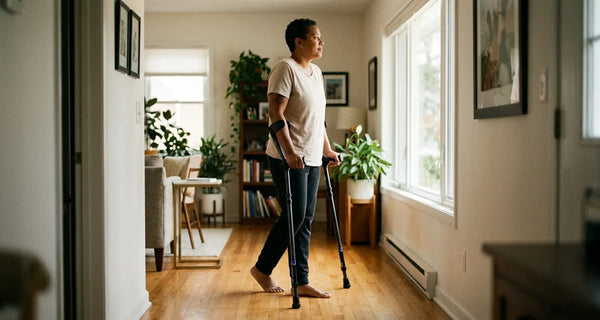
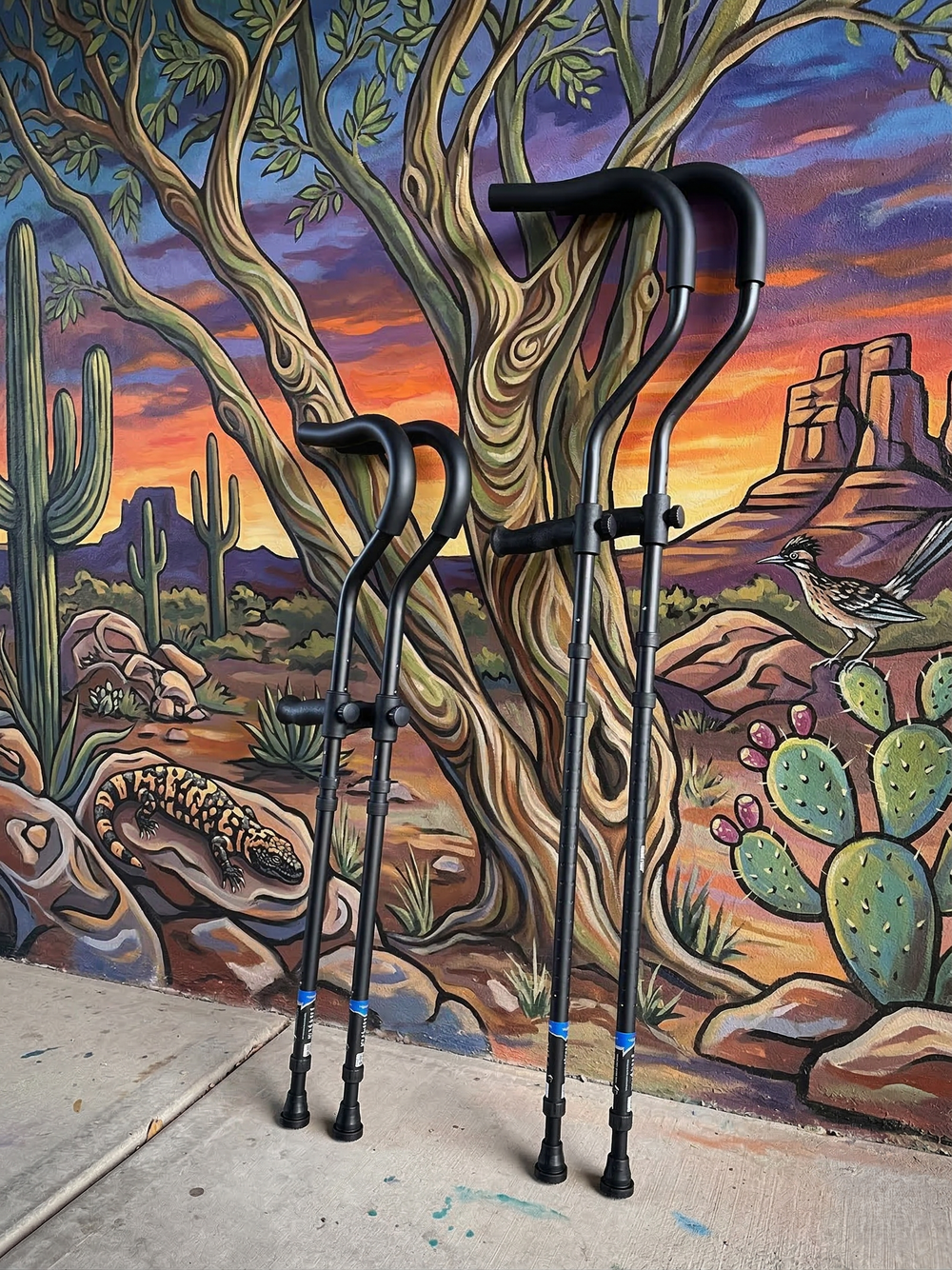
The in-Motion forearm crutch was designed to solve specific, documented problems with standard crutch design. It is worth understanding what those solutions actually are rather than taking the description on faith. Ergonomic hand grip. The grip is contoured to reduce pressure concentration at the palm and ulnar nerve pathway. Standard crutches place a cylindrical handle under the palm at full body weight with every step. Over weeks of use, that creates real wear on soft tissue. The in-Motion grip distributes contact across a larger, more natural surface area. Shock-absorbing tip. Every step on a crutch sends an impact force up through the handle, wrist, and shoulder. A shock-absorbing tip dissipates a portion of that force before it reaches your arm. This is particularly relevant for people recovering from lower-extremity surgery, who are often putting significant weight through the crutch on the affected side. Lightweight aluminum construction. The frame is designed to minimize weight without sacrificing stability. Less weight per crutch means less fatigue per step, which matters more the longer your recovery runs. Clinical research. There are over 34 published studies examining the performance of forearm crutch designs, with consistent findings around reduced energy expenditure, improved gait efficiency, and lower rates of secondary injury compared to standard underarm crutches. The in-Motion design was developed with this research base in mind. This is not a crutch that was designed for the hospital discharge corridor. It was designed for recovery.The Case Against Cheap Crutches
The argument for buying cheap crutches is obvious: they are cheap. The argument against them is less obvious until you have lived it. Standard aluminum crutches are designed for short-term transport use. They are adequate for getting from the discharge desk to your car, or for a few days of limited weight-bearing after a minor injury. They are not designed for six to twelve weeks of daily use during surgical recovery. The consequences of extended use on poorly designed crutches are well-documented:- Shoulder impingement and rotator cuff strain from improper load transfer through the arm
- Carpal tunnel-like wrist and hand pain from concentrated grip pressure
- Axillary nerve compression from improper underarm pad positioning or use
- Increased fatigue that leads to gait compensation patterns, which can strain the knee, hip, and back
How to Buy With FSA/HSA
Buying with your FSA or HSA at millennialmedical.com is straightforward. At checkout, you can pay directly with your FSA or HSA debit card. The card works like a standard Visa or Mastercard. The purchase is automatically recorded as a medical expense. If your card is declined, this occasionally happens if the card issuer requires a secondary verification step for purchases outside of traditional medical providers. In that case:- Pay out of pocket at checkout using a regular debit or credit card.
- Save your receipt (millennialmedical.com will email you one).
- Log in to your FSA or HSA provider's portal and submit the receipt for reimbursement.
The Bottom Line
You are going to spend pre-tax health dollars on crutches anyway. The only question is which crutches. At a 22% bracket, the effective cost of the in-Motion crutch is roughly what you would spend on two or three physical therapy co-pays. Given what poorly designed crutches can cost you in secondary injury and extended recovery, that is a comparison worth sitting with. Spend the FSA/HSA dollars on something that earns them. Shop the in-Motion crutch -- forearm (E0110) and spring-assisted underarm (E0117) -- at millennialmedical.com. Both models ship directly to your door and are accepted by FSA and HSA debit cards at checkout.More in This Series
Part of Millennial Medical's guide to using FSA and HSA dollars on crutches:- Are Crutches FSA and HSA Eligible? Yes. Here's What to Know
- How to Pay for Crutches With Your FSA or HSA Card
- FSA vs. HSA for Crutches: Which Account Saves You More?
- FSA Expiration: Don't Let Your Tax-Free Dollars Go to Waste on the Wrong Crutches
- HSA and Crutches: Why Quality Mobility Aids Are a Smart HSA Purchase
- Best Crutches to Buy With FSA or HSA Dollars (2026 Guide) (you are here)
This guide is part of our FSA and HSA Resource Hub, where you'll find every option for getting crutches covered.