HSA and Crutches: Why Quality Mobility Aids Are a Smart HSA Purchase
Your FSA expires. Your HSA does not.
That single difference changes how you should think about every purchase you make with your health savings account. Unlike a flexible spending account, your HSA balance rolls over indefinitely, earns interest, and can be invested like a retirement account. There is no deadline to spend it. There is no "use it or lose it" pressure pushing you toward mediocre choices in December.
Which means when you buy crutches with your HSA, you have the space to buy the right ones.
This post walks through why crutches are one of the most sensible HSA purchases you can make, who benefits most from thinking this way, and how a slightly advanced strategy can turn your HSA into a tool that works even harder for you over time.
Quick Recap: What Makes an HSA Different
If you are already familiar with how HSAs work, feel free to skip ahead. If not, here are the facts worth knowing before you make any HSA purchase decision. Triple tax advantage. Contributions go in pre-tax (or are tax-deductible if you contribute directly). The money grows tax-free inside the account. And when you withdraw it for qualified medical expenses, you pay no taxes on it. That is three separate points where the IRS does not take a cut. No deadline to spend. Your balance rolls over every year with no penalty. There is no annual expiration, no grace period, no forfeiture risk. Investment option. Most HSA providers allow you to invest your balance in mutual funds, index funds, or ETFs once you hit a minimum threshold. Your HSA can grow significantly over time if you let it. Requires a High Deductible Health Plan (HDHP). To contribute to an HSA, you must be enrolled in a qualifying HDHP. For 2025, that means a minimum deductible of $1,650 for individuals or $3,300 for families. The contribution limits for 2025 are $4,300 for individuals and $8,550 for families.Are Crutches HSA Eligible?
Yes. Crutches are unambiguously HSA-eligible as durable medical equipment (DME) under IRS Publication 502. They have been for decades. Two things worth knowing: No prescription required. Since the CARES Act of 2020, you no longer need a doctor's prescription to buy crutches and have them qualify as a tax-advantaged medical purchase. You can buy them directly, pay with your HSA card, and you are done. Both forearm and underarm models qualify. The in-Motion forearm crutch (HCPCS code E0110) is HSA eligible. The in-Motion spring-assisted underarm model (HCPCS code E0117) is HSA eligible. There is no meaningful distinction in IRS eligibility between crutch types -- if it is a crutch used for mobility, it qualifies.The Long-Term Recovery Scenario
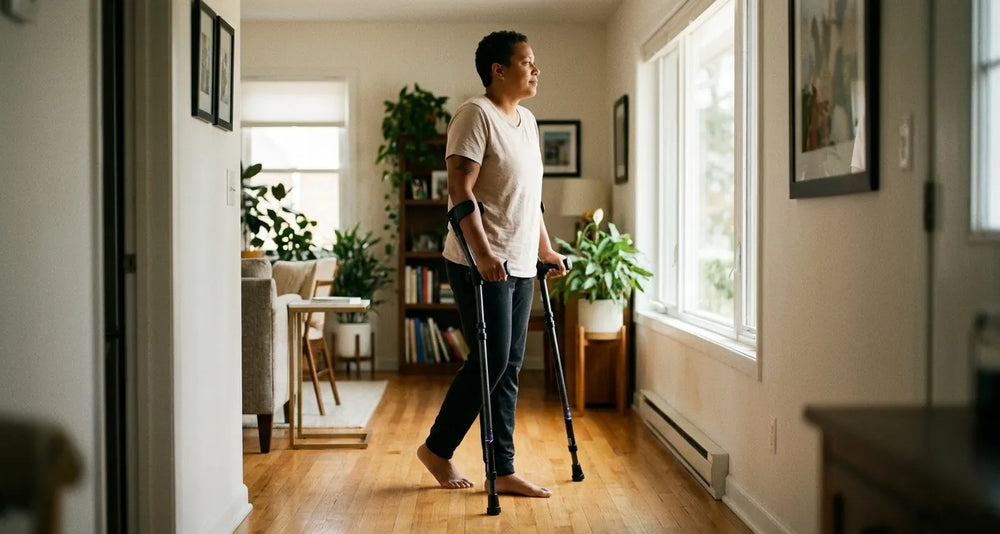
Some recoveries are short. You sprain your ankle, you are on crutches for two weeks, you move on with your life. Others are not. ACL reconstruction. Hip replacement. Tibial fracture. Ankle fusion. These recoveries unfold over months, not days. You may be non-weight-bearing for four to six weeks, then partial weight-bearing for another four to eight weeks, with a gradual return to normal activity that can stretch well past the three-month mark. During that window, the crutch you are using has consequences that extend beyond your leg. Standard aluminum crutches put significant stress on the axilla (the armpit area) and create pressure points at the wrist and palm. Used for weeks at a time, they contribute to shoulder impingement, rotator cuff strain, ulnar nerve compression, and wrist pain. These are not rare edge cases -- they are common enough that physical therapists have a term for them: crutch-related secondary injuries. If you are already managing a surgical recovery, the last thing you need is to compound it with new problems in your shoulder or wrist. This is exactly the scenario where the quality of your crutch matters most, and where spending HSA dollars on something designed for sustained use makes clear medical sense. You are not buying a luxury item. You are protecting your body from a second round of injury during an already difficult recovery.The Chronic Condition Scenario
Not everyone who uses crutches is in acute post-surgical recovery. Many people use mobility aids intermittently or long-term because of underlying conditions: multiple sclerosis, cerebral palsy, peripheral neuropathy, chronic ankle instability, degenerative joint conditions. For these patients, a crutch is not a temporary inconvenience. It is a piece of equipment they live with, and its ergonomic quality matters even more over time. The financial calculus here is also worth thinking through. A $139 pair of quality crutches used over several years -- compared to cycling through multiple cheaper pairs that wear out, fail, or simply cause enough discomfort that you stop using them properly -- is a very different picture. And if you ever do need a replacement, your HSA can cover that purchase too.The HSA Reimbursement Strategy (Advanced)
This is where things get interesting for people who like to optimize. Most HSA holders assume you have to pay with your HSA card at the point of purchase. You do not. The IRS rules say that qualified medical expenses are reimbursable from your HSA as long as the expense occurred after you opened the account. There is no deadline for when you have to file that reimbursement. Here is what that makes possible:- You buy crutches today. You pay out of pocket. You save the receipt.
- You leave your HSA fully invested in an index fund.
- Five years from now, after 7% average annual growth, that $139 has grown to roughly $195 in your account.
- You submit your receipt and reimburse yourself $139 -- tax-free -- from an account that has appreciated while you waited.
What to Buy With Your HSA
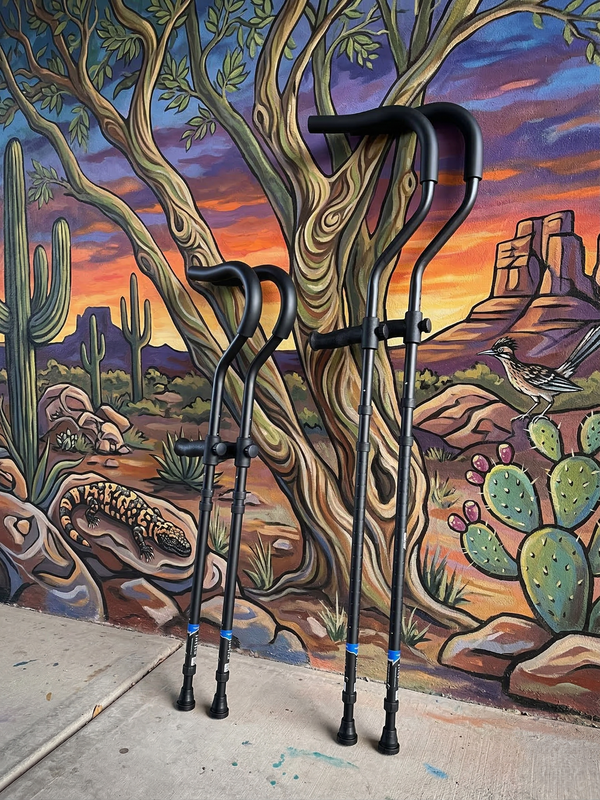
If you are going to spend HSA dollars on crutches, spend them on something designed to support an actual recovery. The in-Motion forearm crutch was designed specifically to address the problems that standard crutches create. The ergonomic hand grip redistributes pressure across the palm and wrist rather than concentrating it at pressure points. The shock-absorbing tip reduces impact stress through the arm and shoulder with every step. The lightweight aluminum frame reduces fatigue on longer-distance use. There are over 34 published clinical studies examining the advantages of forearm crutch design over standard models in areas like energy expenditure, gait efficiency, and secondary injury risk. This is not marketing language. It is a body of research that reflects real differences in how crutch design affects the body during recovery. A $30 pair from the hospital gift shop is designed to get you from the discharge desk to your car. It is not designed for eight weeks of post-surgical ambulation. Your HSA is a tax-advantaged account built to help you take your health seriously. Use it that way. Ready to use your HSA on a crutch that actually earns it? Shop the in-Motion crutch at millennialmedical.com. Both models are FSA/HSA eligible and ship directly to your door.More in This Series
Part of Millennial Medical's guide to using FSA and HSA dollars on crutches:- Are Crutches FSA and HSA Eligible? Yes. Here's What to Know
- How to Pay for Crutches With Your FSA or HSA Card
- FSA vs. HSA for Crutches: Which Account Saves You More?
- FSA Expiration: Don't Let Your Tax-Free Dollars Go to Waste on the Wrong Crutches
- HSA and Crutches: Why Quality Mobility Aids Are a Smart HSA Purchase (you are here)
- Best Crutches to Buy With FSA or HSA Dollars (2026 Guide)
This guide is part of our FSA and HSA Resource Hub, where you'll find every option for getting crutches covered.