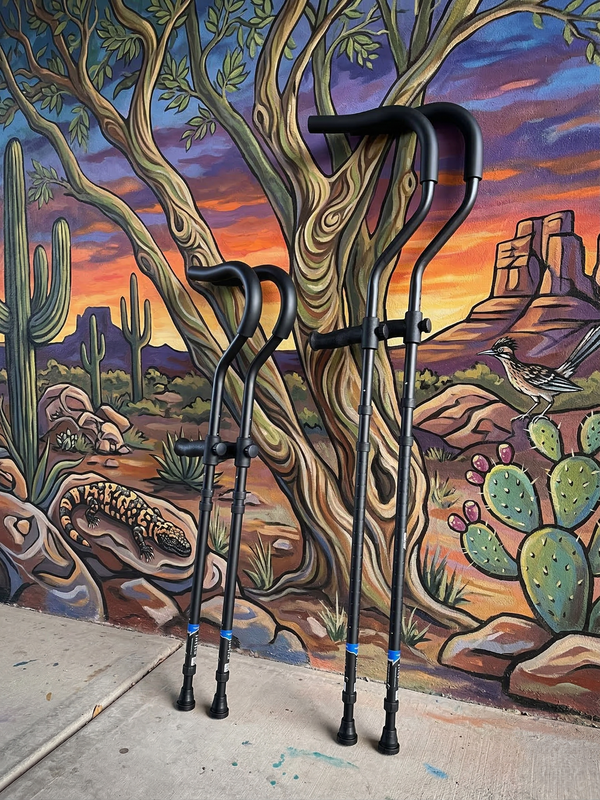
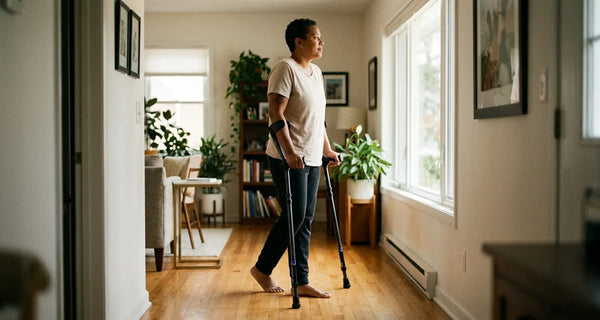
If you have money sitting in a Flexible Spending Account or a Health Savings Account and you need crutches, the good news is simple: both accounts cover them. Crutches are IRS-recognized durable medical equipment under Publication 502, and thanks to the CARES Act of 2020, you don't even need a prescription to make the purchase.
The honest answer to "FSA or HSA?" is that both save you real money. But the right choice depends on which account you actually have, what your balance looks like, and whether you're up against a deadline. This post walks through the differences so you can make the call that keeps the most money in your pocket.
The Quick Comparison
Before diving into the details, here's a side-by-side look at the two accounts:
| Feature |
FSA |
HSA |
| 2025 Contribution Limit |
$3,300 |
$4,300 individual / $8,550 family |
| Use-It-or-Lose-It |
Yes |
No |
| Rolls Over |
Limited (up to $640) |
Yes, unlimited |
| Requires High-Deductible Health Plan |
No |
Yes |
| Investment Option |
No |
Yes |
| Tax Advantage |
Pre-tax contributions only |
Triple (contributions, growth, withdrawals) |
The short version: FSAs are more accessible but come with deadlines. HSAs are more powerful but require a specific type of health insurance.
When to Use Your FSA for Crutches
The clearest case for using your FSA is urgency. If you already have an FSA through your employer, you have a balance, and you're approaching the end of your plan year, using those dollars on crutches is one of the smartest moves you can make.
FSA funds are use-it-or-lose-it. The standard deadline is December 31, though your employer may offer one of two options: a grace period that extends your spending window through March 15 of the following year, or a rollover that lets you carry over up to $640. Your plan can offer one or the other -- not both. If you're not sure which applies to you, check your Summary Plan Description or ask your HR department.
If your balance will be forfeited and you know crutches are in your near future -- whether from a scheduled surgery, an ongoing injury, or a chronic condition -- buying now is not an impulse purchase. It's a disciplined use of money you've already earned and set aside.
The other FSA case: you simply need crutches right now and you have the balance. Don't overthink it. Use the account.
When to Use Your HSA for Crutches
HSA accounts work differently, and that difference opens up options that FSAs simply can't offer.
The most important thing to understand about an HSA is that there is no deadline to use the funds. You can contribute money in 2025, leave it untouched, and reimburse yourself for a qualified expense in 2035. The IRS does not require you to submit a claim within any particular window, as long as you purchased the item after your HSA was established.
This creates what some people call the HSA reimbursement strategy. Here's how it works: you pay for crutches out of pocket today, keep the receipt, and let your HSA balance continue to grow -- including through investment gains if your plan allows it. Years later, even in retirement, you can reimburse yourself for that purchase tax-free. In effect, your out-of-pocket payment becomes an interest-free loan to yourself, and the HSA funds keep compounding in the background.
For people with HSAs and no immediate deadline pressure, this can be the smarter long-term move. But if you'd rather just use the funds now, that works too. The flexibility is the point.
The Math on Both
The tax savings from either account come from the same basic mechanic: you're spending pre-tax dollars. The amount you save depends on your marginal federal income tax bracket. State taxes add a little more.
Here's what that looks like for the in-Motion forearm crutch, priced at $139 per pair (HCPCS E0110):
| Tax Bracket |
Crutch Price |
Tax Savings |
Effective Cost |
| 22% |
$139 |
$31 |
$108 |
| 24% |
$139 |
$33 |
$106 |
| 32% |
$139 |
$44 |
$95 |
The math is identical whether you use an FSA or an HSA for the immediate purchase. The difference is that HSA dollars can grow before you spend them. If your HSA is invested and earning returns, the $139 you eventually spend may have cost you $100 or less in today's dollars by the time you withdraw it.
For FSA users, the savings are straightforward and immediate. For HSA users, the long-term picture is even better.
Can You Have Both?
In most cases, no. If you're enrolled in an HSA-eligible High-Deductible Health Plan, you generally cannot also contribute to a general-purpose FSA at the same time. The IRS treats them as overlapping accounts for the same purpose.
There is one exception worth knowing: a Limited-Purpose FSA, sometimes called an LP-FSA. This is a specialized FSA that covers only dental and vision expenses (and in some cases, expenses incurred after you've met your deductible). If your employer offers an LP-FSA, you can pair it with your HSA. Many people use the LP-FSA for predictable dental and vision costs so their HSA balance can stay invested and grow.
If you're not sure what type of FSA your employer offers, that's another question worth taking to HR. The distinction matters, and the answer isn't always clear from the account name alone.
The Bottom Line
Here's the practical guidance, stripped down:
If you have an FSA with a deadline approaching: use it. Crutches are an approved purchase, you'll actually use them, and the alternative is losing money you already earned. Don't let the balance evaporate on a lesser purchase when quality crutches are on the table.
If you have an HSA: use it when you're ready. If you want the immediate tax savings, buy now. If you want to maximize the long-term value of the account, pay out of pocket, save the receipt, and reimburse yourself later while the HSA balance grows.
Either way: don't spend your tax-free dollars on $30 aluminum crutches from a pharmacy. The tax savings are the same whether you spend $30 or $139, but the product you walk away with is not.
The in-Motion Crutch: What Your FSA or HSA Dollars Actually Buy
The in-Motion forearm crutch (HCPCS E0110) is a spring-assisted, ergonomically designed forearm crutch that returns energy with each step. It's built for people who need crutches for more than a few days -- people in real recoveries, dealing with real injuries, who need a tool that works with their body instead of against it.
At $139 per pair, it lands comfortably within both FSA and HSA eligibility. After tax savings, most users pay between $95 and $108 depending on their bracket. That's the price of a crutch you'll actually want to use, rather than one you'll abandon in a closet after three days.
If you're ready to use your FSA or HSA balance,
shop the in-Motion crutch at millennialmedical.com. Orders ship quickly, and both FSA and HSA payments are accepted at checkout.
More in This Series
Part of Millennial Medical's guide to using FSA and HSA dollars on crutches:
Be kind. Be generous. Always pay it forward.
This guide is part of our FSA and HSA Resource Hub, where you'll find every option for getting crutches covered.