Helping Your Child Thrive on Crutches at School
Home you can control. School is the part that keeps parents up at night. Crowded hallways, a heavy backpack, stairs between classes, a cafeteria tray your child suddenly cannot carry, and a building that was not designed with your kid in mind this week.
The good news is that schools deal with this more often than you would think, and most of the friction comes down to a few practical problems with practical fixes. Some of it is logistics. Some of it is paperwork that gets your child real support. And some of it is simply rehearsing the tricky moments before the first bell.
This guide covers the accommodations worth asking for, how to handle backpacks and stairs and lunch, and how to set your child up to feel capable instead of singled out.
New to crutches with your child? Start with our parent's guide to crutches for kids, then come back for the school piece. Our guide to walking safely indoors and out helps too.
The honest answer to “how do we make school work?”
You get the school on your side early, and you handle the building the day before, not the morning of. The families who do well almost always do two things. They put the right support in writing, and they walk the actual route with their child once before everyone is watching.
The thing most parents do not realize is how much help a school is required to give. A child whose injury or condition limits a major life activity like walking can qualify for formal accommodations, and that turns a stack of small worries into a plan the staff has to follow.
Get the right support in writing: 504 plans and IEPs
Two tools matter here, and they are not the same.
504 plan
A 504 plan removes barriers so your child can access school like everyone else. It is the usual route for a child on crutches, including a temporary situation like a broken leg, because walking is a major life activity. Most 504 accommodations do not change what your child learns. They change how they get around and get through the day.
Common accommodations for a student on crutches include leaving class a few minutes early to beat the hallway crowd, a second set of books kept at home so the backpack stays light, elevator access where stairs are involved, help carrying materials between classes, a seat near the door, and extra time to get from room to room without a tardy.
IEP
An IEP is for a child who needs specialized instruction, not just access, and it applies when a disability affects learning itself. A child with a longer-term condition may already have one. If so, mobility supports can be added to it. For most short-term crutch situations, a 504 plan is the faster and more fitting tool. Ask the school counselor or the 504 coordinator how to start, and ask for it in writing.
The backpack problem, solved
Here is the thing about crutches. Both hands are busy, so your child carries almost everything on their back. That makes the backpack the most important piece of gear in the building.
- Use a sturdy backpack worn on both shoulders, never one strap. The load should ride high and close to the back.
- Pack it the night before so your child can skip locker trips between classes. Fewer hallway crossings means fewer chances to get jostled.
- Ask the doctor for a note requesting two sets of books or full digital access, so heavy texts never have to travel.
- A water bottle and small items go in a crutch bag clipped to the crutch, not in the hands.
The hard moments of the school day
These are the three moments that trip kids up, so rehearse them.
Stairs
If the school has an elevator, get elevator access into the plan and use it. Where stairs cannot be avoided, your child takes them slowly with a hand on the railing. Up with the stronger leg first, down leading with the crutches. Practice this at home on a few steps with you spotting before your child does it solo at school.
Hallways
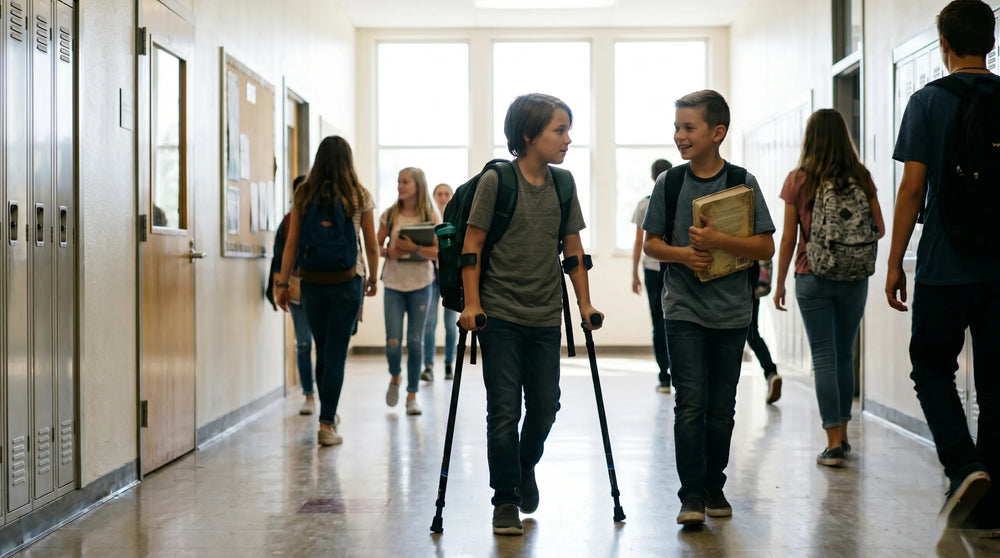
Crowds are the real hazard, not the distance. Leaving class a few minutes early lets your child move while the halls are clear. A buddy who walks with them and carries a bag turns a stressful crossing into a normal one.
Lunch
A tray is impossible on crutches. Arrange for a friend or staff member to carry it, or for your child to use a lunch bag they can keep in the backpack. Sort this out before day one so it is not a daily scramble.
The rules that matter most
Walk the route the day before. From drop-off to first class to the cafeteria to the bathroom, do the real path once so nothing is a surprise.
Name a point person. One staff member, usually the counselor or nurse, who owns the plan and whom your child can go to if something is not working.
Let friends help. Kids want to pitch in, and a classmate carrying books is good for your child socially as well as physically. Teach your child to accept help gracefully and to ask for it without embarrassment.
Shoes that stay on, tips that grip. The same home rules apply at school. Secure shoes and rubber crutch tips with good tread.
Why the right crutches make school easier
School is a long day on your feet with a full backpack. Crutches that hurt the hands or force a hunch make every one of those harder, and a child who dreads their crutches will avoid moving, which is the opposite of what you want.
Forearm crutches help here because they let a child free one hand to open a door, grab a railing, or take a tray handle without dropping anything. The In-Motion forearm crutch was built around more than three years of development and 34 medical studies on how crutches load the hands and wrists, with a contoured forearm platform and ergonomic grip that ease the pressure of a long school day. Kids and adult sizes are at the In-Motion shop.
When to check in with the school or doctor
- Your child is skipping the bathroom or lunch because getting there is too hard. That is a sign the plan needs adjusting, not that your child needs to tough it out.
- New hand numbness, tingling, or sore palms, which usually means fit or technique needs a look.
- Repeated near-falls in a specific spot, which points to a building barrier the school should address.
- Your child seems withdrawn or anxious about going in. Loop in the counselor early.
The bottom line
School on crutches is mostly a logistics problem, and logistics problems have solutions. Put the support in writing, fix the backpack, rehearse the stairs and the lunch line, and give your child a point person and a buddy.
Do that, and the building stops being the enemy. Your child gets to spend their energy on being a student and a kid, which is exactly where it should go.
Frequently asked questions
Does my child need a 504 plan just for crutches?
Not always, but it helps, especially if crutches will be in the picture for more than a couple of weeks. A 504 plan puts accommodations like early dismissal, elevator access, and help with books in writing, so support does not depend on whichever teacher is on duty. Ask the school's 504 coordinator how to start.
How does my child carry books and a lunch tray on crutches?
Books go in a sturdy two-strap backpack, packed the night before to avoid locker trips, with a second set kept at home so nothing heavy travels. A tray is not workable on crutches, so arrange for a friend or staff member to carry it, or pack a lunch your child keeps in the backpack.
Should my child use the stairs or the elevator?
Use the elevator when one exists, and write elevator access into the plan. Where stairs are unavoidable, go slowly with a hand on the railing, leading up with the stronger leg and down with the crutches. Practice on a few steps at home first.
How do I handle gym class and recess?
Talk to the teacher and the school about modified participation rather than sitting out entirely. Many kids can take part in adapted ways, and staying included matters for confidence. Your child's doctor can clarify what is safe.
My child is embarrassed about crutches at school. What helps?
Rehearse the routine at home so the first day back is not also the first day on crutches. Let your child accept help from friends, which builds connection rather than isolation. And give them small choices, like crutch color or a crutch bag, so the equipment feels like theirs.