Resource Center — Medical Solutions
Foot & Ankle Surgery: Your Complete Crutch Recovery Guide
Foot and ankle surgery is one of the most varied categories in orthopedics. The procedures range from a 30-minute bunion correction to a complex multi-hour ankle reconstruction, and the recoveries vary just as widely. Some patients are weight-bearing in a surgical shoe within 48 hours. Others are completely non-weight-bearing for eight weeks or more, with the bone or tissue healing slowly under strict protection.
That variation is what makes pre-op planning so important. The crutches you need, the home setup that will work, the timeline for getting back to driving, and the rules that determine whether your surgery succeeds all depend on which procedure you’re actually having.
This guide walks through the major categories of foot and ankle surgery, what realistic crutch timelines look like for each, the rules that matter most during the non-weight-bearing or partial-weight-bearing phase, and how to make the recovery survivable.
Recovering from a different procedure? Try our companion guides for ACL Surgery, Hip Replacement, Meniscus Surgery, or Knee Replacement.
The Honest Answer to "How Long?"
Foot and ankle recovery timelines on crutches range from a week to more than three months. The most important factor is whether your procedure involved bone, tendon, ligament, or just soft tissue. Each of those tissues heals at a very different speed. Soft-tissue procedures (bunion correction, plantar fascia release, neuroma excision, tendon debridement) usually allow weight-bearing in a surgical shoe or boot within days, with crutches used for one to three weeks for balance and pain control. Bone procedures (osteotomies, fracture repair, fusions) usually require strict non-weight-bearing for four to eight weeks while the bone heals, then a progressive return to weight-bearing in a boot. Ligament and tendon repairs (ankle ligament reconstruction, peroneal or posterior tibial tendon repair) usually require four to six weeks non-weight-bearing followed by a controlled return to weight-bearing in a brace or boot. If your surgeon hasn’t told you exactly which type of procedure you’re having, ask. The answer determines almost everything else.Realistic Recovery Timelines After Foot and Ankle Surgery
Your surgeon’s specific instructions take priority over any general timeline. Bunion surgery (bunionectomy / osteotomy):- Days 1 to 7: Surgical shoe or boot. Heel weight-bearing only. Crutches for balance and to offload the forefoot.
- Weeks 2 to 6: Continued protected weight-bearing in shoe or boot. Crutches gradually phased out as comfort allows.
- Weeks 6 to 12: Transition to regular shoes (often only roomy ones at first). Most patients off all walking aids.
- Months 3 to 6: Swelling continues to resolve. Full activity return for most patients.
- Weeks 1 to 2: Splint, then transition to a walking boot. Strict non-weight-bearing on crutches.
- Weeks 2 to 6: Continued non-weight-bearing or touch-down weight-bearing on crutches in the boot.
- Weeks 6 to 8: Progressive weight-bearing in the boot. Crutches phased out.
- Weeks 8 to 12: Out of the boot, into supportive shoes. PT intensifies.
- Months 4 to 6: Return to running, cutting, and pivoting sports.
- Weeks 1 to 2: Splint or cast. Strict non-weight-bearing on crutches. Significant swelling and pain.
- Weeks 2 to 6: Transition to a walking boot. Continued non-weight-bearing or touch-down weight-bearing.
- Weeks 6 to 12: Progressive weight-bearing in the boot as the bone consolidates. Crutches usually phased out by week 10 to 12.
- Months 3 to 6: Out of the boot. PT focuses on regaining strength, range of motion, and balance.
- Months 6 to 12: Most patients near full recovery. Stiffness and swelling can linger.
- Weeks 1 to 6: Cast or boot, strict non-weight-bearing on crutches. The bones being fused need uninterrupted protection to grow into a single unit.
- Weeks 6 to 12: Progressive weight-bearing in the boot as imaging confirms fusion. Crutches phased out gradually.
- Months 3 to 6: Transition to supportive footwear. PT adapts to the changed mechanics of the joint.
- Months 6 to 12: Most patients reach steady-state function. The fused joint won’t regain its original motion. The goal is pain-free, stable walking.
- Days 1 to 7: Surgical shoe or boot. Weight-bearing as tolerated. Crutches for the first few days as needed for pain and swelling.
- Weeks 2 to 4: Continued weight-bearing in the boot or supportive shoe. Most patients off crutches by the end of week one or two.
- Weeks 4 to 6: Transition to regular supportive shoes. Activity restrictions gradually lift.
The Crutch Rules That Matter Most
Foot and ankle recoveries depend on the bone, tendon, or ligament getting protected weight-bearing exactly as prescribed. The most common reason these surgeries fail is patients bearing weight before the tissue is ready. Non-weight-bearing means non-weight-bearing. Even putting the foot down briefly to balance, or "tapping" the toe on the floor, can disrupt healing if your surgeon has prescribed strict NWB. Touch-down weight-bearing (TDWB) is a different prescription. It means a specific small amount of weight is allowed for balance only, not for actual weight transfer. Use both crutches every step. The temptation to hop on the good leg without crutches is real. Don’t. Hopping is the leading cause of falls in this population, and a fall onto an unhealed surgical foot is a near-guaranteed second surgery. Wear the boot or splint exactly as prescribed. If your surgeon says "sleep in the boot," sleep in the boot. If your surgeon says "only remove for showering," only remove for showering. Boots and splints are part of the protocol. They’re not optional accessories. Stairs: up with the good, down with the bad. Lead with the good leg going up. Lead with the crutches and the operated leg going down. One step at a time, slowly, every time. Elevate. Foot and ankle surgeries swell more than almost any other category of orthopedic procedure. Elevation is one of the few things that genuinely helps. Get the foot at or above heart level for most of the first two weeks. Most patients underestimate how much elevation actually matters until they try it.Setting Up Your Home Before Surgery
Foot and ankle recoveries are often the longest crutch experiences in orthopedics. Some patients are on crutches for two months or more. Home setup is one of the highest-leverage decisions you make before surgery. Try to set up on one floor. Stairs on crutches with a boot are slow, fatiguing, and the most common location for falls. If you can sleep on the main floor for the first four to six weeks of an NWB recovery, do it. Sort out the bathroom. A shower chair, a non-slip mat, and a handheld shower head are essential. A waterproof boot cover lets you shower with the boot off without compromising the dressing. A raised toilet seat helps if balance is shaky. Set up an elevation station. A recliner or couch with a stack of pillows where you can comfortably keep the foot above heart level for hours at a time. This is where you’ll spend most of the first two weeks. Make it a place you actually want to be. Get a small backpack. Carrying anything in your hands while on crutches is impossible. A backpack lets you move drinks, ice packs, your phone, and books without setting down a crutch. Stock the kitchen ahead of time. Pre-cook and freeze meals for the first two weeks. Move the things you use every day to counter or eye level. A rolling office chair or kitchen stool can make food prep workable while non-weight-bearing. Driving is off the table for weeks. Right-foot or right-ankle surgery typically means no driving for six to twelve weeks depending on the procedure. Left-foot surgery in an automatic transmission may allow earlier return, but check with your surgeon. Reaction time matters as much as pain. Consider a knee scooter as a complement, not a replacement. Many foot and ankle patients use a knee scooter for longer distances and crutches for tight spaces and stairs. The two are complementary tools, not either-or.Why Crutch Choice Matters More for Foot & Ankle Recovery
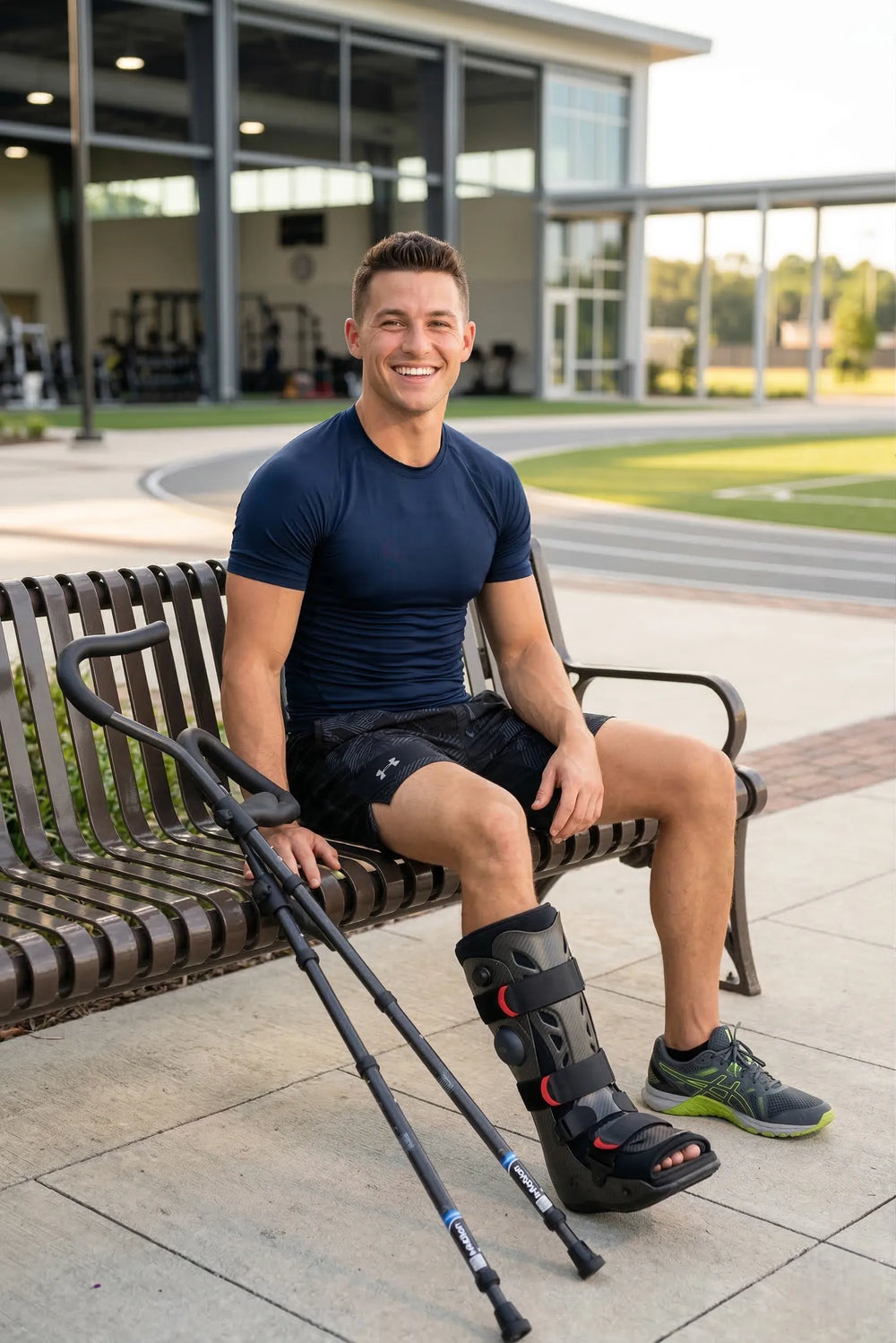
Foot and ankle surgery patients are often on crutches longer than any other orthopedic category. They’re using them for the most demanding kind of crutch use too: complete non-weight-bearing, where every step transfers the patient’s entire body weight through the upper body and the good leg. Standard underarm crutches were not designed for this kind of load over this kind of timeline. After two or three weeks of NWB use, most patients develop secondary symptoms. Shoulder strain. Wrist pain. Hand numbness from grip pressure. The kind of upper-body fatigue that makes PT harder. Chronic ache in the good knee from over-loading. These aren’t minor complaints. They’re the leading reason patients stop following NWB protocols and start hopping or "cheating" with weight on the operated foot, which is the single fastest way to wreck a foot or ankle surgery. That’s why we built the In-Motion crutch the way we did. The spring-assist mechanism absorbs impact before it reaches the joints, which cuts the cumulative upper-body load with every step. The design came out of three years of development and a review of 34 medical studies on crutch-related strain. For foot and ankle patients facing four to eight weeks of NWB use, that reduction matters as a compliance tool more than a comfort one. The easier the crutches are to tolerate, the more likely the patient is to actually follow the protocol that determines whether the surgery worked. Shop crutches for foot and ankle surgery recovery →When to Call Your Surgeon
Foot and ankle surgeries have specific complications that need fast attention. Call your surgeon immediately if any of these show up:- Calf pain, swelling, warmth, or tenderness. Possible deep vein thrombosis. Foot and ankle patients are at elevated DVT risk because of the long non-weight-bearing window.
- Sudden shortness of breath or chest pain. Call 911. Possible pulmonary embolism.
- Numbness, tingling, or color change in the toes. May mean a cast or boot is too tight, or a more serious nerve or vascular issue.
- New redness, warmth, or drainage from the incision. Possible infection. Foot and ankle infections can compromise the surgery.
- Fever above 101°F
- A sudden change in foot position, or a new pop or shift. May indicate hardware failure, suture failure, or a refracture.
- Pain getting worse instead of slowly better. The trajectory should be steady improvement, even if it’s slow.