Resource Center — Recovery Guide
Broken Ankle Recovery: A Patient's Guide to the Crutch Phase
This guide covers general recovery ranges, not personal medical advice. Your surgeon's specific instructions always override anything you read here.
A broken ankle is one of those injuries that flips your life sideways in a single afternoon. One bad step off a curb, one awkward landing, and suddenly you cannot put weight on a foot you never thought about until now. The pain is real, but the part that catches most people off guard is how long the crutch phase lasts and how much of the recovery depends on what you do in the first several weeks.
Here is the honest version. Most broken ankles keep you off that foot for about six weeks, and the full recovery runs longer than almost anyone expects going in. The good news is that ankle fractures heal well when you protect them, and the crutch phase, miserable as it feels, is temporary.
This guide walks through what a realistic recovery looks like, the rules that actually determine your outcome, and how to get through weeks on crutches without wrecking your hands and shoulders in the process.
Recovering from something else? Try our companion guides for Foot and Ankle Surgery, Achilles Tendon Repair, Meniscus Surgery, and Knee Replacement.
The Honest Answer to "How Long?"
Most ankle fractures need at least six weeks for the bone to reach early healing, and about 10 to 12 weeks for complete healing. If your fracture is stable and does not need surgery, the ankle often takes 12 to 16 weeks to feel solid. If you needed surgery to repair more than one bone, it can be up to two years before the ankle feels fully normal, though you are walking long before that.
The single biggest factor is whether your fracture is stable or unstable. A stable fracture, where the bones are still lined up, is often treated without surgery in a cast or boot. An unstable fracture, where the bones have shifted or more than one bone is broken, usually needs surgery with plates and screws to hold everything in place while it heals.
The thing most patients do not know going in: the length of time you stay off the foot is not about how much it hurts. It is about how long the bone needs to be protected before it can safely carry your weight. That window is set by your surgeon and your imaging, not by how good you feel on a given morning.
Stable vs. Surgical: Two Different Recovery Paths
Your surgeon's specific instructions take priority over any general timeline below.
Stable ankle fracture, treated without surgery:
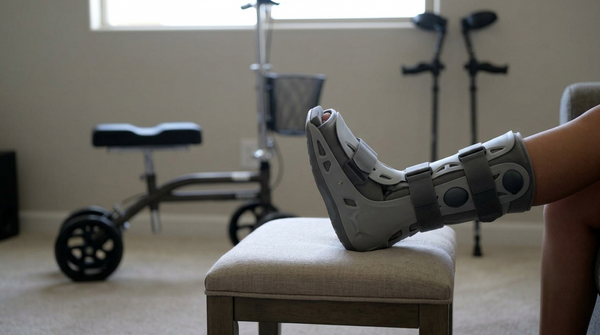
- Weeks 1 to 6: Cast or walking boot. Non-weight-bearing or touch-down weight-bearing on crutches, depending on the fracture. This is the strict phase.
- Weeks 6 to 8: Repeat imaging confirms healing. Gradual progression from partial weight-bearing, often starting around 20 percent of your body weight, toward full weight-bearing in the boot. Crutches phase out during this window.
- Weeks 8 to 12: Out of the boot and into supportive shoes. Physical therapy for strength, motion, and balance.
- Months 3 to 4: Most daily activity returns. Stiffness and swelling can linger past this point.
Surgical ankle fracture (ORIF, plates and screws):
- Weeks 1 to 2: Splint or cast. Strict non-weight-bearing on crutches. Significant swelling and pain are normal early on.
- Weeks 2 to 6: Transition to a walking boot. Continued non-weight-bearing or touch-down weight-bearing on crutches.
- Weeks 6 to 12: Progressive weight-bearing in the boot as the bone consolidates. Crutches usually come off during this phase.
- Months 3 to 6: Out of the boot. PT intensifies. Strength and balance return.
- Months 6 to 12: Most patients are near full recovery. Some stiffness and swelling can persist, which is normal.
One detail worth knowing. Research shows patients who transition into a walking boot get off crutches noticeably sooner than patients kept in a plaster cast, walking without crutches in roughly 1.4 weeks versus 3.1 weeks in one study. If a boot is an option for you, ask about it.
The Rules That Matter Most
A broken ankle heals on a simple principle: protect the bone until it can carry load, then load it gradually. Almost everything that goes wrong comes from breaking that principle early.
Non-weight-bearing means non-weight-bearing. If your surgeon says no weight, even resting the toes down to steady yourself counts as weight. That small cheat, repeated over weeks, can shift a healing fracture. When you are told touch-down weight-bearing, it means the foot rests on the floor for balance only, not to carry you.
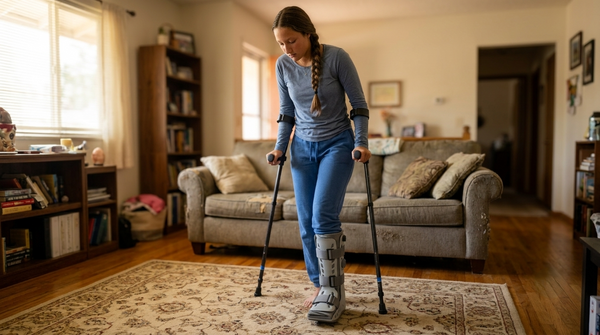
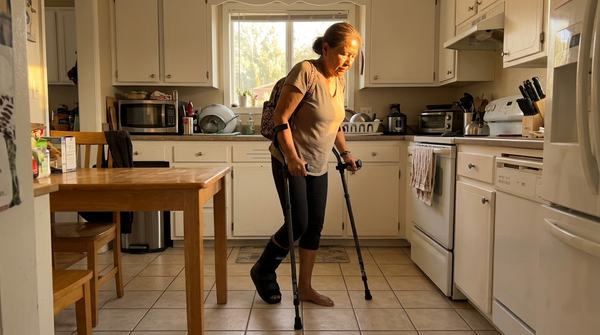
Use both crutches, every step. Hopping on the good leg without crutches is how people fall and turn one injury into two. Keep the crutches with you even for short trips across a room.
Keep the ankle elevated, especially the first two weeks. Ankle fractures swell a lot, and swelling slows healing and makes everything hurt more. Get the ankle above heart level whenever you are sitting or lying down.
On stairs, lead with the good leg going up and the crutches going down. Say it to yourself the first few times. Up with the good, down with the bad.
Do not skip the follow-up imaging. The X-rays at weeks six and beyond are what tell your surgeon it is safe to start loading the ankle. That is the gate you have to pass, and there is no shortcut around it.
Setting Up Your Home Before You're Stuck
If you are reading this right after the injury, some of this ship has sailed, but most of it you can still fix in an afternoon with help from a friend or family member.
Try to live on one floor for the first few weeks. Stairs on crutches are slow and tiring, and they are where most preventable falls happen. If your bedroom is upstairs, consider camping out downstairs for a while.
Sort out the bathroom. A shower chair, a non-slip mat, and a handheld shower head turn the most dangerous room in the house into a manageable one. Getting clean on one leg is harder than people expect.
Set up an elevation station. A spot on the couch or a recliner with a stack of pillows, within reach of a charger, water, and whatever you need, so you can keep the ankle up without getting up every ten minutes.
Get a small backpack. You cannot carry anything in your hands on crutches. A backpack lets you move a plate, a phone, or a book from one room to another without a second trip.
Clear your paths. Loose rugs, cords, and clutter on the floor are trip hazards when you are on crutches. Walk your main routes and clear them before you need them.
Why Crutch Choice Matters More Than You'd Think
Here is the part nobody warns you about at the ER. Six weeks on standard underarm crutches is hard on the rest of your body. All the weight that used to go through your leg now goes through your hands, wrists, and shoulders. By the second week, a lot of ankle patients have sore palms, aching shoulders, and that tingling in the hands that comes from leaning into the underarm pads. Some develop nerve irritation from resting weight in the armpit, a problem serious enough that it has a name: crutch palsy.
Standard crutches were built to be cheap and universal, not to carry a person comfortably for a month and a half. That is the gap we set out to close when we designed the In-Motion crutch. The spring-assist post built into the lower shaft absorbs the impact of each step and returns some of that energy on the upswing, so your hands and shoulders take less of a beating over a long recovery. The contoured hand grips are angled to keep your wrist in a natural position instead of kinking it, which is where a lot of the hand and wrist pain comes from. It holds up to 350 pounds.
For a six-week recovery, the crutches you use are not a small detail. They are what you are living on. Shop crutches for broken ankle recovery →
When to Call Your Surgeon
Some symptoms during ankle recovery need fast attention. Call your surgeon or seek care right away if you notice:
- Calf pain, swelling, warmth, or tenderness. This can be a sign of a deep vein thrombosis, a blood clot. Immobilized lower-leg patients are at higher risk.
- Sudden shortness of breath or chest pain. Call 911. This can signal a pulmonary embolism, a clot that has traveled to the lungs.
- Numbness, tingling, or a color change in the toes. This can mean a cast or boot is too tight, or something more serious with circulation.
- New redness, warmth, or drainage from a surgical incision. This can indicate infection.
- Fever above 101 degrees Fahrenheit.
- Pain that is getting worse instead of slowly better. The overall trend should be steady improvement, even if some days are worse than others.
The Bottom Line
A broken ankle is a real recovery, not a quick fix, and the honest timeline is longer than most people hope. But ankle fractures heal well when they are protected, and the patients who do best are the ones who take the non-weight-bearing window seriously and set their lives up to get through it.
The crutch phase is the hardest stretch, and it is temporary. Protect the bone, keep the ankle up, use both crutches every step, and get through the six weeks. What feels endless right now is a small slice of a recovery you are very likely to make in full.
Frequently Asked Questions
How long will I be on crutches with a broken ankle?
For most people, about six weeks of limited or no weight on the foot, sometimes a little less for a stable fracture and longer for a complex surgical repair. Your follow-up X-rays are what determine when you start putting weight down.
Can I walk on a broken ankle without crutches?
Not during the protected phase. Putting weight on a healing fracture before your surgeon clears it can shift the bones and set your recovery back. Even touching the foot down to balance counts as weight if you were told to stay non-weight-bearing.
Is a walking boot better than a cast?
For many stable fractures, a boot lets you get out of crutches sooner and is easier to live with, and research backs that up. Whether a boot is right for your fracture is your surgeon's call, so ask if it is an option for you.
Why do my hands and shoulders hurt more than my ankle?
Because all the weight your leg used to carry now goes through your arms. This is extremely common on standard crutches, especially past the first week. Better-fitted, ergonomic crutches that keep your wrist neutral and absorb impact make a real difference over a six-week recovery.
When can I drive again?
If the break is on your right side, plan on no driving for the whole non-weight-bearing phase and until you can move the foot safely and are off strong pain medication. A left ankle in an automatic car is sometimes cleared sooner. Confirm with your surgeon before you get behind the wheel.
How do I sleep with a broken ankle?
On your back with the ankle elevated on a pillow is easiest early on, since it keeps swelling down. If you are in a splint or boot, wear it to sleep exactly as your surgeon instructed.