Resource Center — Recovery Guide
Achilles Tendon Surgery Recovery: Navigating the Non-Weight-Bearing Phase
If you've just been told you need Achilles tendon surgery, or you're already a few days post-op trying to figure out what the next several weeks look like, you're dealing with one of the longest, most demanding non-weight-bearing recoveries in orthopedic medicine. Unlike most leg surgeries where patients start bearing at least some weight within days, Achilles repair keeps you fully off the foot for six to ten weeks. The crutch phase is long. And it matters more than most patients realize until they're already in it.
This post covers what the non-weight-bearing phase actually looks like after Achilles tendon repair, realistic timelines, what determines how fast you progress, how to set up your home, and how to protect your upper body during weeks of crutch use that almost no other recovery demands.
If you're recovering from a different procedure, see our companion guides: ACL Surgery, Hip Replacement, Meniscus Surgery, Knee Replacement, and Foot & Ankle Surgery.
What Makes Achilles Recovery Different
The Achilles tendon is the largest, strongest tendon in your body. It connects the calf muscle to the heel bone and generates the force that propels you forward with every step. When it ruptures, and it's almost always during a sudden push-off or change of direction, it tears partially or completely.
Surgical repair reattaches the ends of the tendon. But the tendon itself heals slowly. Tendons have poor blood supply compared to muscle or bone, and the repaired tissue needs real time to regain the strength to handle load. That's why Achilles repair has the longest non-weight-bearing period of any procedure in this hub. The tendon isn't ready before it's ready.
Two practical consequences follow. First, the crutch phase is longer, six to ten weeks fully off the foot is standard, versus two to four weeks after knee replacement or one to four weeks after ACL repair. Second, the demands on your upper body are higher. Six to ten weeks of daily crutch use puts a cumulative load on wrists, hands, shoulders, and elbows that most patients aren't prepared for. We'll come back to that.
Realistic Timelines
Your surgeon's and physical therapist's specific instructions take priority over any general timeline. Achilles recovery protocols vary depending on whether you had an acute rupture or a chronic tendinopathy repair, your surgeon's philosophy, and how the repair went intraoperatively.
Days 1–7 (Week 1)
- Your foot is non-weight-bearing. You'll be on crutches or a knee scooter immediately.
- The foot is immobilized in a splint or cast with the toe pointed down (plantarflexion). That position takes tension off the repair.
- Elevation is critical this week. Keep the foot above heart level as much as possible to control swelling. Swelling is the enemy of early healing.
- Pain is most intense in the first three to five days and then starts to ease.
- Most patients aren't doing formal physical therapy yet. The goal this week is rest, elevation, and ice.
Weeks 2–6
- You're still fully non-weight-bearing. The foot stays in the boot or cast.
- The boot angle gradually shifts from plantarflexion toward neutral, toes-down moving toward flat over several follow-up visits.
- Physical therapy starts somewhere in this window, initially passive range of motion, then gentle active movement as the repair gains strength.
- Crutch technique starts to matter a lot here. You're in it for the long haul, and six weeks of sloppy mechanics adds up.
- Swelling peaks around weeks two to three and then starts coming down.
Weeks 6–10
- Partial weight-bearing starts somewhere in this window, depending on your surgeon's protocol and how the repair is progressing.
- The transition is gradual: a few pounds through the foot first, then increasing over days and weeks.
- Many patients go from two crutches to one crutch, then to a walking boot with no crutch during this phase.
- Physical therapy picks up, calf strengthening, range of motion, gait retraining.
Months 3–6
- Most patients are walking in a regular shoe and doing structured PT by month three.
- Return to running isn't before four to six months and depends on functional strength testing.
- Return to sport, anything involving jumping, sprinting, or cutting, is nine to twelve months or longer.
The Non-Weight-Bearing Rules That Matter Most
Achilles repair is unforgiving of early load. The most common cause of re-rupture is patients putting weight on the foot before the repair is ready. The rules here aren't suggestions.
Fully non-weight-bearing means exactly that
Not "mostly off it." Not "just a quick step." Your surgeon will tell you when you can begin loading the foot, and it'll be explicit. Until that conversation happens, the foot doesn't touch the floor with weight behind it.
Get your crutch technique right early
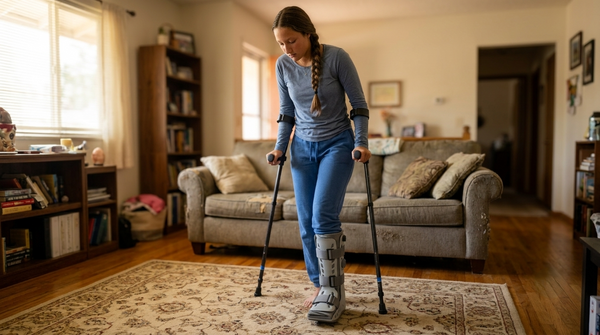
Achilles patients are on crutches longer than almost any other surgical population. Sloppy technique compounds over weeks, wrist pain, shoulder strain, and axillary nerve compression from leaning on underarm crutches are all common in long recoveries. If you're using forearm crutches, the cuff sits on your forearm, not your wrist, and the handle sits at wrist-crease height when your arm is straight. If you're not sure your technique is right, ask your physical therapist to check it in the first week. Don't wait until week four when something already hurts.
Elevation isn't optional
The Achilles repair sits at the far end of your circulatory system, the bottom of your body. Gravity works against healing here. Every hour you spend with the foot below heart level is an hour of increased swelling and slower recovery. A foam wedge under the mattress, a recliner set slightly above heart level, and a real habit of keeping the foot elevated during any rest period aren't comfort measures. They're treatment.
Protect the boot
The walking boot isn't just for weight-bearing protection, it holds the ankle in the position that protects the repair even when you're resting. Follow your surgeon's instructions on when to remove it. In the early weeks, that's bathing and PT exercises, and that's about it. Sleeping in the boot is standard for most surgeons through the first four to six weeks.
Setting Up Your Home for Achilles Recovery
This recovery is long enough that your home setup makes a real difference in quality of life. Set things up before surgery if you can.
- Arrange for single-level living. Stairs on crutches are manageable, but exhausting, and you'll be on crutches for months. Moving your sleeping and living space to one level removes the most dangerous and tiring movement you'd otherwise do multiple times a day.
- Get a shower chair and a waterproof boot cover. Keeping the repair dry is non-negotiable. Waterproof cast covers are available online and at medical supply stores. A shower chair turns a daily anxiety into a routine.
- Set up a recovery station. A recliner or elevated chair with everything you need within arm's reach, water, medications, phone charger, ice packs, a small cooler. The goal is to cut down on unnecessary crutch trips around the house.
- Get a backpack. You can't carry anything in your hands while using crutches. A backpack solves that completely, drinks, snacks, your phone, whatever, without putting down a crutch.
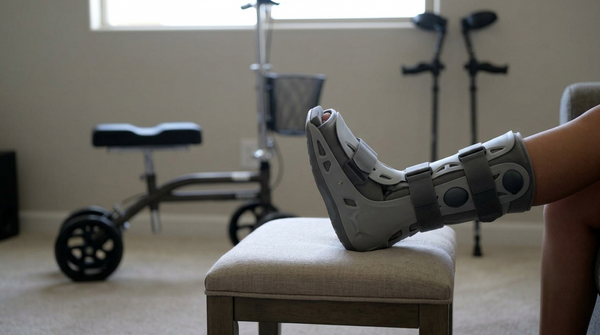
- Consider a knee scooter for indoors. For six to ten weeks of non-weight-bearing, a knee scooter can seriously reduce fatigue for longer indoor distances and activities like cooking. They don't work on stairs or uneven surfaces, so most patients use them alongside crutches rather than instead of them.
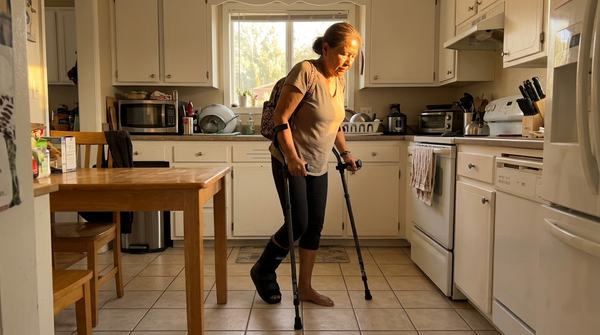
- Pre-cook and freeze meals for the first few weeks. Cooking on crutches is genuinely hard. Stock the freezer ahead of time and move frequently used items to accessible heights before the surgery date.
Why the Crutches You Use Matter for Achilles Recovery
Achilles patients are the population for whom crutch quality matters most. You're using them daily for six to ten weeks, longer than almost any other surgical patient. The cumulative load on wrists, hands, shoulders, and elbows over that time is substantial.
Standard axillary (underarm) crutches transfer every step's impact directly into the hands and armpit. Over a week, that's manageable. Over six to ten weeks, it's a significant source of secondary pain, the shoulder strain, wrist ache, and hand numbness that Achilles patients report as the part of recovery nobody warned them about.
Forearm crutches distribute load more ergonomically, keep the wrists in a neutral position, and eliminate axillary pressure entirely. For a recovery measured in months, that difference adds up.
The In-Motion crutch goes further with a spring-assist mechanism that absorbs impact before it reaches the wrist and arm joints. For an Achilles patient doing thousands of crutch steps a day for six to ten weeks, that reduction in cumulative upper-body load translates directly into less secondary pain, better stamina for physical therapy, and a lower risk of developing the wrist and shoulder problems that can outlast the Achilles recovery itself.
Shop crutches for Achilles tendon recovery →
When to Call Your Surgeon
Call your surgeon immediately if you experience any of the following:
- A sudden pop or giving-way sensation in the repaired area, possible re-rupture, which is a surgical emergency
- Significant new swelling, warmth, or redness around the repair site, possible infection or DVT
- Calf pain, tightness, or swelling above the repair, possible deep vein thrombosis
- Fever above 101°F
- Pain that's getting worse rather than gradually better beyond the first week
- Wound drainage that's increasing or changing in appearance
Frequently Asked Questions
How long will I be fully non-weight-bearing after Achilles surgery?
Most patients are fully non-weight-bearing for six to ten weeks, depending on the type of repair and the surgeon's protocol. Partial weight-bearing starts somewhere between weeks six and ten, and the transition to full weight-bearing in a boot typically happens between weeks eight and twelve.
Can I use a knee scooter instead of crutches?
A knee scooter is a solid option for many Achilles patients, especially for longer indoor distances. The operated leg rests on the padded platform and you propel yourself with the other foot. They don't work on stairs or rough outdoor surfaces, so most patients use them alongside crutches rather than as a full replacement. Ask your surgeon and physical therapist what makes sense for your situation.
When can I drive after Achilles surgery?
If it's your right foot, driving is off the table until you're cleared for full weight-bearing and have regained sufficient strength and reaction speed, eight to twelve weeks at minimum, often longer. If it's your left foot and you drive an automatic, your surgeon may clear you earlier. But always confirm before getting behind the wheel. The criteria are reaction time and emergency braking ability, not just pain level.
When will I be able to walk normally again?
Most patients are walking in a regular shoe by three to four months and feeling close to normal by six months. Running comes back between four and six months. Full return to cutting, jumping, and sport is nine to twelve months or longer. The tendon keeps strengthening and remodeling for up to two years after repair, this recovery doesn't end at the six-month mark, it just becomes less visible.
Will my Achilles ever be the same?
With appropriate surgical repair and solid rehabilitation, most patients regain full function. High-level athletes return to their sport. The repaired tendon is structurally sound, though it may feel different and take longer to trust than before. The key variables are how well you follow the post-op protocol and the quality of your physical therapy, those two things matter more than almost anything else in determining your outcome.