Resource Center — Recovery Guide
Lisfranc Injury Recovery on Crutches: The Long Road Through the Midfoot
This guide covers general recovery ranges, not personal medical advice. Your surgeon's specific instructions always override anything you read here.
A Lisfranc injury is one of the most underestimated injuries in the foot. It happens in the midfoot, where a cluster of small bones and ligaments connects the front of your foot to the back, and it ranges from a subtle sprain to a serious fracture-dislocation. The frustrating part is that a mild Lisfranc injury is often mistaken for a bad sprain, which is exactly why some people limp on it for weeks before anyone realizes what it is.
However it happened, a Lisfranc injury usually means a long stretch off the foot while the midfoot heals. This guide explains the difference between the mild and severe versions, what a realistic recovery looks like, and how to get through weeks or months on crutches without wearing out the rest of your body.
If your injury is elsewhere, our guides on Broken Foot Recovery, Broken Ankle Recovery, and Foot and Ankle Surgery may fit better.
The Honest Answer to "How Long?"
A stable Lisfranc injury, where the bones have not shifted, is often treated without surgery in a non-weight-bearing cast or boot for about six to eight weeks, followed by a gradual return to weight and physical therapy. An unstable injury, where the joints have moved, usually needs surgery, and the recovery is longer.
After surgery, you can expect a non-weight-bearing period of several weeks, then a stretch in a protective boot with slowly increasing weight, adding up to as much as three months in a cast or boot. Getting back to running and sport commonly takes six to seven months, and sometimes longer. This is not a quick injury, and knowing that up front helps you plan for it.
The thing most people do not know going in: the midfoot carries and transfers your weight with every step, so it cannot be rushed. Loading it before it is ready can cause the bones to shift again, which is why the non-weight-bearing rule is taken so seriously here.
Stable vs. Unstable: Two Very Different Injuries
Your surgeon's specific instructions take priority over any general timeline. The single biggest factor is whether the midfoot is stable.
- Stable Lisfranc injury (a sprain without displacement): often managed without surgery. Non-weight-bearing in a cast or boot for roughly six to eight weeks, then graduated weight-bearing and rehab. Your surgeon confirms stability with imaging, sometimes weight-bearing X-rays.
- Unstable Lisfranc injury (bones or joints shifted): usually needs surgery to put the midfoot back in place and hold it, either with screws and plates or by fusing the affected joints. The recovery is longer and the non-weight-bearing period is strict.
Because a mild Lisfranc injury can look like an ordinary sprain, it is worth getting midfoot pain checked properly if it is not improving, especially if there is bruising on the bottom of the foot, which is a classic warning sign. Missing an unstable Lisfranc injury can lead to long-term problems.
A Realistic Timeline for a Surgical Lisfranc Injury
Your surgeon's plan takes priority. This is a common path after surgery for an unstable Lisfranc injury:
- Weeks 1 to 3: Splint or cast. Strict non-weight-bearing on crutches. Significant swelling and pain early on. Stitches usually come out around two weeks. Keep the foot elevated.
- Weeks 3 to 6: Transition toward a protective boot, still non-weight-bearing or touch-down only, depending on your surgeon.
- Weeks 6 to 12: Progressive weight-bearing in the boot as imaging confirms healing. Crutches phase out during this window. Physical therapy begins in earnest.
- Months 3 to 6: Out of the boot and into supportive shoes. Strength, balance, and motion work continue. Everyday walking returns for most people.
- Months 6 and beyond: Return to running and higher-impact activity, often around six to seven months, once your surgeon clears it. Some stiffness can linger.
The Rules That Matter Most
A Lisfranc injury heals on the same principle as any midfoot injury: protect the joints until they are stable, then load them gradually. With the midfoot, the stakes are high because those joints take your weight on every step.
Take non-weight-bearing seriously, even the small cheats. Resting the foot down to steady yourself, or standing on it for a second to reach something, still loads the midfoot. That is exactly the kind of thing that can shift the bones and set your recovery back.
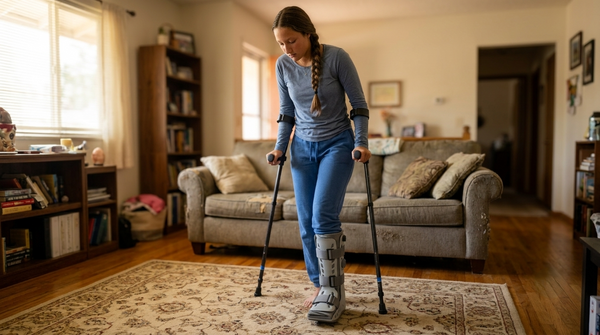
Use both crutches, every step, during the protected phase. This is not the injury to hop across a room on. A fall onto a healing midfoot is a serious setback.
Keep the foot elevated, especially the first few weeks. Midfoot injuries swell a lot, and swelling slows healing and makes the boot feel tight and miserable. Get the foot above heart level whenever you sit or lie down.
Do not skip your follow-up imaging. The X-rays are what confirm the midfoot is holding its position and that it is safe to add weight. There is no way to feel your way to that call.
Commit to the rehab. The midfoot gets stiff after weeks of immobilization, and physical therapy is what restores the motion and strength you need to walk normally again. Skipping it leaves many people stiffer and weaker than they need to be.
Setting Up Your Home for a Long Recovery
A Lisfranc injury can keep you on crutches for weeks to months, so a real setup pays off.
Try to live on one floor for the first stretch. Stairs on crutches with a foot you cannot load are slow and are where most falls happen. Set up a base downstairs if your bedroom is up.
Make the bathroom safe. A shower chair, a non-slip mat, and a handheld shower head take the danger out of getting clean on one foot.
Build a command center. A recliner or couch with pillows for elevation, plus water, a charger, and whatever you use during the day within reach, so you are not up and down constantly.
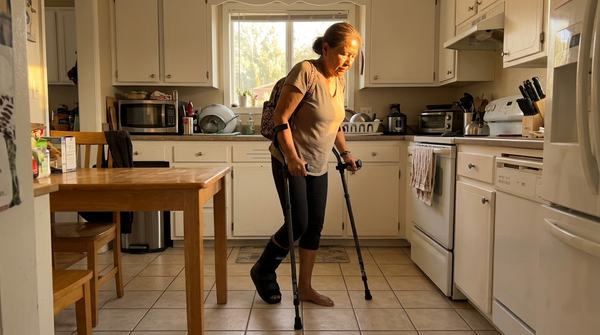
Use a backpack for carrying and clear your paths of rugs and cords. On crutches your hands are full and your balance is compromised, so remove the trip hazards before you are moving.
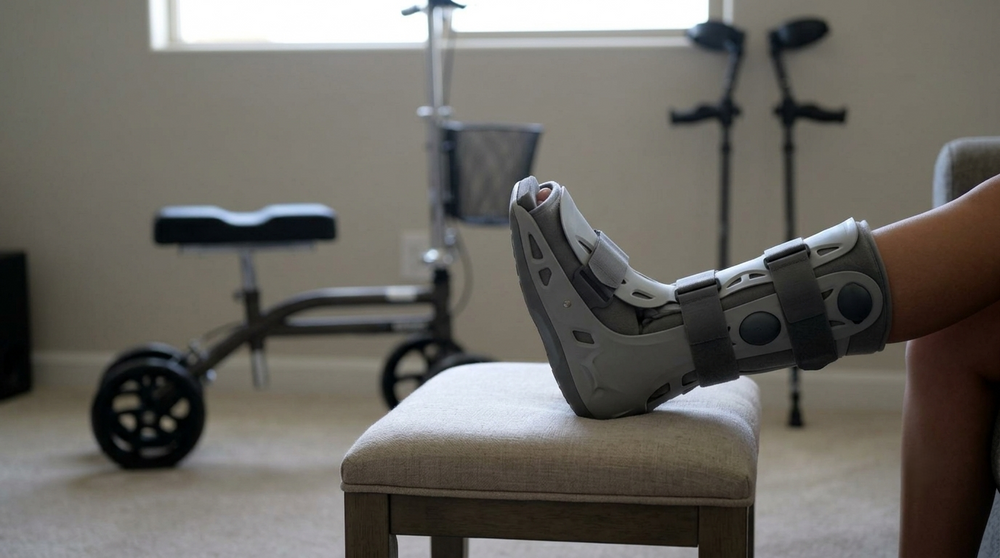
Consider a knee scooter for longer distances. Many midfoot patients use crutches around the house and a knee scooter for bigger trips, since months on crutches is genuinely tiring.
Why Crutch Choice Matters More Over Months
A Lisfranc recovery is one of the longer ones in the foot, and over weeks or months the crutches become one of the hardest parts of it. All the weight your foot used to carry now runs through your hands, wrists, and shoulders, thousands of times a day. Standard underarm crutches were built to be cheap and universal, not to carry a person comfortably for that long, and by a few weeks in, a lot of patients have sore palms, aching shoulders, and nerve irritation from leaning on the pads.
That is the gap we set out to close with the In-Motion crutch. The spring-assist post built into the lower shaft absorbs the impact of each step and returns some of that energy on the upswing, so your hands and shoulders take less of a beating over a long recovery. The contoured hand grips are angled to keep your wrist in its natural position instead of kinking it back, which is where a lot of the hand and wrist pain starts. It holds up to 350 pounds and comes in forearm and underarm models, so you can match it to your recovery.
When your recovery is measured in months, the crutches are not a detail. They are what you live on every day until the midfoot is ready. Shop crutches for Lisfranc injury recovery →
When to Call Your Surgeon
Call your surgeon or seek care right away if you notice:
- Calf pain, swelling, warmth, or tenderness. This can signal a deep vein thrombosis, a blood clot, and immobilized lower-limb patients are at higher risk.
- Sudden shortness of breath or chest pain. Call 911. This can mean a pulmonary embolism.
- Increasing numbness, tingling, or severe pain out of proportion, especially in a tight cast. This can be a sign of dangerous pressure that needs urgent care.
- A color change in the foot or toes, or a foot that feels cold.
- New redness, warmth, or drainage from a surgical incision, or fever above 101 degrees Fahrenheit.
The Bottom Line
A Lisfranc injury is easy to underestimate and slow to heal, and the honest timeline is longer than most people hope, especially when surgery is involved. The midfoot carries your weight with every step, so it has to be fully protected before it can be loaded, and your imaging, not your pain level, is what clears you to walk.
The crutch phase is the long, grinding part, and it is temporary. Protect the foot, keep it elevated, take the non-weight-bearing window seriously, and do the rehab. Most people come through a Lisfranc injury and get back to walking well, even if it takes patience to get there.
Frequently Asked Questions
How long will I be on crutches with a Lisfranc injury?
For a stable injury treated without surgery, usually about six to eight weeks non-weight-bearing before you start adding weight. For a surgical Lisfranc injury, expect several weeks strictly off the foot, then a protective boot with gradual weight-bearing, adding up to as much as three months in a cast or boot.
Can a Lisfranc injury heal without surgery?
Yes, if it is stable and the bones have not shifted. Those are often treated in a non-weight-bearing cast or boot for six to eight weeks, then graduated weight-bearing. Unstable injuries, where the joints have moved, usually need surgery to heal properly.
Why is a Lisfranc injury such a big deal?
Because the midfoot transfers your weight with every step, and if the injured joints are not fully healed and aligned, they can cause long-term pain and arthritis. It is also easy to mistake a mild Lisfranc injury for a sprain, so it can be missed, which makes the outcome worse.
How do I know if my foot injury is a Lisfranc injury and not a sprain?
You often cannot tell without imaging. Classic clues include bruising on the bottom of the midfoot, pain across the top of the midfoot, and difficulty bearing weight. If a suspected sprain is not improving, get it checked, because a missed Lisfranc injury is a serious problem.
When can I run again after a Lisfranc injury?
For surgical injuries, returning to running and sport commonly takes about six to seven months, and sometimes longer. Your surgeon clears you based on healing and your progress in physical therapy, not on the calendar alone.