Hand and Palm Pain From Crutches: Why It Happens and How to Fix It
This is general information, not personal medical advice. If your symptoms are severe or not improving, talk to your doctor about your situation.
Nobody warns you that the crutches might end up hurting more than the injury. You expected the sore leg. What you did not expect is that a week in, your palms are raw, the base of your hands aches, and your fingers feel stiff or tingly by the end of the day. If that is where you are right now, you are not doing anything wrong, and you are not imagining it.
Hand and palm pain is one of the most common complaints among people on crutches, and it has a clear cause. It also has real fixes, some of which you can do today with the crutches you already have, and one that solves the problem closer to its root.
Already dealing with sore shoulders and wrists too? We have a separate guide on preventing shoulder and wrist pain while using crutches. This one is about the hands and palms specifically.
Why Crutches Hurt Your Hands
When you use crutches correctly, you are supposed to carry your weight through your hands, not your armpits. That is the right technique, but it comes with a cost. Every step sends a large share of your body weight straight down through your palms and into the grips. Do that a few thousand times a day and the tissue at the base of your hands gets overloaded.
The base of your palm is not a great place to park your body weight. Two of the main nerves that run into your hand pass through that area, and steady pressure on them is what produces the numbness and tingling that so many crutch users describe, often in the ring and pinky fingers or across the palm. The friction of gripping hard, meanwhile, is what raises blisters and builds calluses.
There is a second problem that makes the first one worse: wrist angle. On a lot of standard crutches, the grip forces your wrist to bend backward as you push down. That bent-back position, held under load, increases pressure inside the carpal tunnel, which is the same mechanism behind a lot of everyday wrist and hand pain. So you get hit twice, once from the weight on your palm and once from the angle of your wrist.
Sore Hands vs. a Warning Sign
Some hand soreness during crutch use is expected. Aching palms and tired grip muscles at the end of a long day are the normal price of getting around on your arms for a while. That kind of soreness eases with rest overnight and gets better as you get stronger and eventually off the crutches.
Numbness and tingling are a different signal. If your fingers go numb, tingle, or feel weak, that is a nerve being compressed, and it is worth paying attention to. Most of the time it settles once the pressure is relieved, but lasting numbness or weakness is a reason to check in with your doctor rather than push through. The same goes for pain that keeps getting worse instead of leveling off.
What Actually Helps
There are two layers here. The first is a set of adjustments and habits that take the edge off. The second is the crutch itself, which is where the problem usually starts. Both are worth doing, so start with the quick wins.
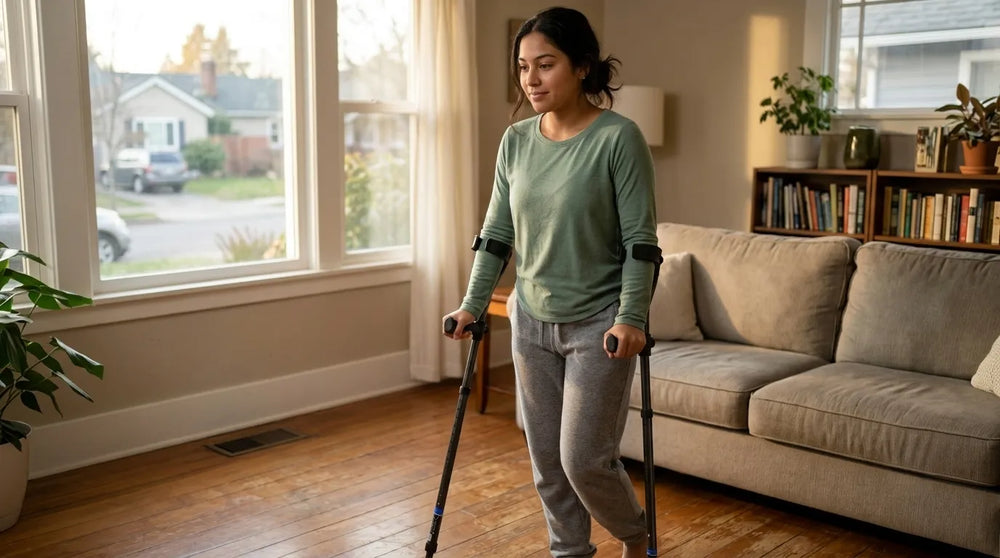
Get the height right. This is the most common fix people miss. When the hand grips are set correctly, your elbow should bend about 15 to 30 degrees when you hold them, and the top of an underarm crutch should sit a couple of finger-widths below your armpit. Grips set too low force you to hunch and push through a bent wrist. Have someone help you check the fit, because it is hard to judge on yourself.
Stop gripping so hard. A lot of hand fatigue comes from white-knuckling the grips out of nervousness. Your weight should rest down through relaxed hands, not a death grip. It feels unnatural at first and it saves your hands real wear.
Add padding, but know its limits. Gel grip covers or padded cycling-style gloves spread the pressure over more of your palm and cut down on blisters. They help. What they do not do is change where your weight is going or fix a bad wrist angle, so treat them as a comfort layer, not a cure.
Take pressure off when you can. Sit down for tasks you would normally stand for. Use a backpack so you are not carrying things in already-loaded hands. Every minute your palms are not bearing weight is recovery time.
Keep the wrist as neutral as possible. If your crutch grips let you adjust the angle, aim for a position where your wrist stays fairly straight rather than cocked back. The straighter the wrist, the less pressure on the carpal tunnel.
Why the Crutch Itself Is Usually the Real Problem
You can do everything above and still have sore hands, because most standard crutches are built around a straight grip and a rigid pole. The straight grip does nothing to protect your wrist angle, and the rigid pole passes the full shock of every step straight up into your palm. Padding and technique work around that design. They do not change it.
This is the exact problem we set out to solve with the In-Motion crutch. Two things about it target hand and palm pain directly. First, the hand grips are contoured and angled with a slight downward tilt, which aligns the bones of your arm and hand and keeps your wrist in its natural position instead of kinking it back. That takes pressure off the carpal tunnel area, which is where a lot of the numbness and tingling comes from. Second, the spring-assist post built into the lower shaft absorbs the impact of each step instead of sending it into your hands, and it returns some of that energy as you move, so your hands and wrists are not absorbing the full jolt thousands of times a day.
It holds up to 350 pounds. It comes in forearm and underarm models, both built around the same wrist-friendly grip. If your hands are the thing making your recovery miserable, the crutch is the place to fix it. Shop ergonomic crutches built to protect your hands →
When to See a Doctor
Most hand pain from crutches is a mechanical problem you can improve. See your doctor if you run into any of these:
- Numbness, tingling, or weakness in the hand that does not go away with rest, or that is getting worse over time.
- Loss of grip strength, or trouble with fine movements like buttoning a shirt or picking up small objects.
- Pain that keeps climbing instead of leveling off after the first week or two.
- Numbness or tingling that started in your armpit or upper arm rather than your hand, which can point to nerve pressure from leaning on the underarm pads. We cover that specific problem in our guide on crutch palsy.
The Bottom Line
Sore hands are not a sign that you are bad at using crutches. They are a sign that a lot of body weight is going through a small area that was never meant to carry it, often made worse by a grip that bends your wrist the wrong way. Fit your crutches properly, loosen your grip, add padding, and take weight off your hands when you can, and most people feel a real difference.
If the pain sticks around, look hard at the crutches themselves. A grip that keeps your wrist neutral and a design that absorbs impact instead of driving it into your palms can turn the crutch phase from something you dread into something you can actually get through. Your hands are carrying you right now. It is worth giving them the right thing to hold.
Frequently Asked Questions
Why do my hands hurt so much on crutches?
Because your palms are carrying weight that used to go through your leg, and that weight lands on a small area at the base of your hand where sensitive nerves sit. A grip that bends your wrist backward makes it worse. It is extremely common and it is fixable.
Are numb or tingling fingers from crutches something to worry about?
Usually it settles once you relieve the pressure with a better fit, a looser grip, or a wrist-friendly grip design. But numbness or tingling that lingers or worsens is a sign of nerve compression, and that is worth having your doctor look at rather than pushing through.
Do crutch pads or gloves actually help hand pain?
They help with blisters and spread the pressure over more of your palm, so they are worth using. What they cannot do is change where your weight lands or fix a bad wrist angle, so they are a comfort layer rather than a full solution.
How do I stop getting blisters on my hands from crutches?
Loosen your grip so your hands slide less against the grips, use padded gloves or gel grip covers, and make sure your crutch height is right so you are not clenching to stabilize. Keep the skin dry, and cover any hot spot early before it becomes a blister.
What is the best crutch grip for hand and wrist pain?
A contoured grip that is angled to keep your wrist neutral, rather than a straight grip that forces the wrist to bend back. Pairing that with a crutch that absorbs impact, instead of a rigid pole that drives shock into your palm, is what makes the biggest difference for hands over a long recovery.
Will my hand pain go away after I stop using crutches?
For most people, yes. Normal overuse soreness fades once your hands are not carrying your weight anymore. If numbness, weakness, or pain persists after you are off crutches, see your doctor to rule out a nerve issue.