Resource Center — Recovery Guide
Sprained Ankle Recovery: When You Need Crutches and When You Don't
This guide covers general recovery ranges, not personal medical advice. Your surgeon's specific instructions always override anything you read here.
A rolled ankle is one of the most common injuries there is, and also one of the most underestimated. You step off a curb wrong, your ankle turns, and for a few minutes it hurts too much to stand. Then the swelling comes up. The question most people are asking within the hour is simple: is this bad, and do I need crutches?
The honest answer depends entirely on how badly you stretched or tore the ligaments. A mild sprain often has you walking carefully within a day or two. A severe one can put you on crutches for a couple of weeks and take a month or more to fully settle. This guide sorts out which is which, when crutches actually help, and how to recover without turning a one-time sprain into an ankle that keeps giving out.
Dealing with something more serious? If you think a bone may be broken, read our guides on Broken Ankle Recovery and Broken Foot Recovery instead.
The Honest Answer to "How Long?"
Ankle sprains are graded by how much ligament damage there is, and the grade sets the timeline.
- Grade 1 (mild): the ligament is stretched with only tiny tears. Most people recover in about 1 to 2 weeks with early movement and normal walking as tolerated.
- Grade 2 (moderate): the ligament is partly torn. Recovery usually runs 3 to 6 weeks, with a brace or walking boot for support and a gradual return to full weight.
- Grade 3 (severe): the ligament is fully torn. Walking may be impossible at first, and a short spell of immobilization in a boot or cast with crutches, often around 10 to 14 days, is common before you start loading it again.
One thing that surprises people: research now favors getting moving early for most sprains, not resting for weeks. Gentle, protected weight-bearing as tolerated tends to heal ankles faster and stronger than long immobilization. The main exception is the first couple of days and the more severe tears, where offloading the ankle genuinely helps.
There is also a specific injury worth flagging. A high ankle sprain, which involves the ligaments above the joint rather than the usual ones on the outside, heals more slowly and is often more disabling than a standard sprain. If your pain is up the leg above the ankle rather than around the ankle bone, tell your doctor.
When Crutches Actually Help
Crutches are not automatic with a sprain. For a mild one, they can slow your recovery if they keep you from the gentle movement that helps the ankle heal. The rule of thumb is simpler than a grade: if putting weight on the ankle is too painful to walk normally, use crutches until it is not, and then stop.
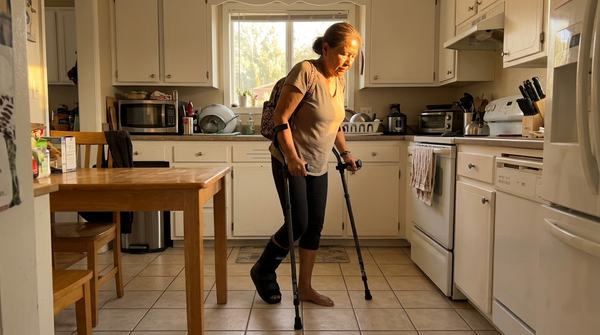
For the first 48 to 72 hours of a moderate or severe sprain, your doctor may want weight off the ankle while the worst of the swelling settles. Crutches let you stay mobile without forcing a painful, limping gait that can strain everything else. As the pain eases, you move from both crutches, to one, to none, usually over days rather than weeks.
The goal is to use crutches as a bridge, not a crutch in the figurative sense. They get you through the acute phase and then get out of the way so the ankle can rebuild its strength and balance.
The Rules That Matter Most
Most sprains heal fine. The ones that turn into chronic, unstable ankles usually got rushed or ignored. A few things make the difference.
Respect the first few days. This is when swelling and pain are worst and when the ligament is most vulnerable. Rest it, ice it, keep it elevated above heart level, and use a compression wrap or brace. If it is too painful to walk on, that is what the crutches are for.
Do not test it by pushing through pain. Sharp pain when you load the ankle is a stop sign, not a challenge. Protected weight-bearing as tolerated means as tolerated, not as forced.
Get back to gentle movement as soon as you reasonably can. Once the sharp pain settles, careful motion and weight-bearing help the ankle heal. Sitting completely still for two weeks tends to leave you stiff and weak.
Do the rehab, even when it feels better. The single biggest reason ankles keep spraining is skipped rehab. Once the pain is gone, balance and strength work is what keeps it from happening again. This is the part almost everyone quits too early.
See a doctor if you could not bear any weight right after the injury, if the ankle is numb, or if the bone itself is tender rather than the soft tissue around it. Those can be signs of a fracture rather than a sprain.
Setting Yourself Up to Heal
A sprain rarely takes over your life the way a fracture does, but a little setup speeds things along.
Keep an elevation spot ready. A couch corner with pillows where you can get the ankle above your heart makes a real dent in the swelling, especially the first few days.
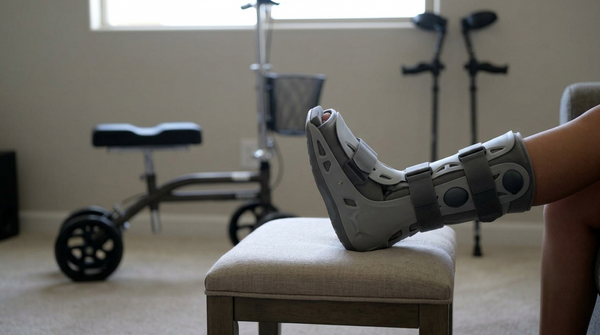
Have a brace or wrap on hand. A lace-up brace or an aircast-style support gives the ankle stability while the ligament heals and makes walking less painful once you are off crutches.
If you are using crutches, use a backpack. Even for a few days, you cannot carry things in your hands on crutches, and a backpack keeps you from making trips you do not need to make.
Clear your walking paths. Loose rugs and clutter are exactly what you do not want when your balance is already off.
Why Crutch Choice Still Matters for a Sprain
Even a short stint on crutches can beat up your hands and shoulders if the crutches are the cheap, rigid kind. All your weight suddenly goes through your palms, and a rigid pole sends the shock of every step straight into your hands. For a few days that is annoying. For a two-week grade 3 sprain, it adds a second sore spot on top of the ankle you are already nursing.
This is the gap we set out to close with the In-Motion crutch. The spring-assist post built into the lower shaft absorbs the impact of each step and returns some of that energy on the upswing, so your hands and shoulders take less of a beating over a long recovery. The contoured hand grips are angled to keep your wrist in its natural position instead of kinking it back, which is where a lot of the hand and wrist pain starts. It holds up to 350 pounds and comes in forearm and underarm models, so you can match it to your recovery.
For a sprain, you may not be on crutches long, but the days you are on them go a lot better on crutches that were actually built for comfort. Shop crutches for sprain and injury recovery →
When to Call Your Doctor
Most sprains do not need a visit, but some do. Seek care if you notice:
- You could not put any weight on the ankle right after the injury, or still cannot after a day or two.
- The ankle bone itself is tender to the touch, rather than the soft tissue around it. This can point to a fracture.
- Numbness, tingling, or a cold or pale foot.
- Pain and swelling that keep getting worse instead of slowly improving after the first few days.
- The ankle feels like it is giving out or will not hold you, especially weeks later. This can mean the ligament did not heal stable.
The Bottom Line
A sprained ankle is usually a good-news injury. Most heal well, and many do not need crutches at all. The trick is matching your response to the severity: protect and offload a bad one early, get moving again once the sharp pain settles, and do not skip the strength and balance work that keeps it from becoming a repeat problem.
If it hurts too much to walk, crutches are the right call for a little while. Use them to get through the worst of it, then hand them back and let the ankle do the rest of the work.
Frequently Asked Questions
Do I need crutches for a sprained ankle?
Only if it hurts too much to walk normally. Mild sprains usually do not need them, and using them too long can actually slow healing. Moderate and severe sprains often need crutches for a few days up to a couple of weeks while the pain settles.
How long does a sprained ankle take to heal?
A mild sprain is often better in 1 to 2 weeks. A moderate one takes 3 to 6 weeks. A severe, fully torn ligament can take longer and may need a short period of immobilization first. High ankle sprains heal more slowly than regular ones.
Should I stay off it completely or walk on it?
For most sprains, gentle protected weight-bearing as tolerated heals the ankle faster than resting it for weeks. The exception is the first couple of days and more severe tears, when offloading helps. If walking causes sharp pain, back off and use support.
How do I know if it is sprained or broken?
You often cannot tell for sure without an X-ray. Signs that lean toward a fracture include not being able to put any weight on it at all, tenderness right on the ankle bone rather than the soft tissue, and numbness. When in doubt, get it checked.
Why does my ankle keep spraining?
Usually because the strength and balance work got skipped after an earlier sprain. Ligaments that healed loose, plus weakened stabilizing muscles, leave the ankle prone to rolling again. Rehab is what breaks that cycle, even after the pain is long gone.